
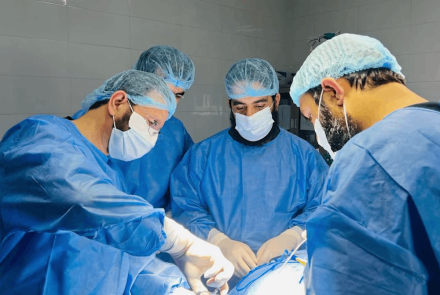
For the first time in Afghanistan, an Afghan neurosurgeon successfully performed a functional neurosurgery procedure at Sheikh Zayed Hospital in Kabul.
Kabul 24: The groundbreaking operation was carried out on a patient named Sabrullah from Baghlan province, who had suffered from severe, burning pain in his finger for years.Three years ago, a bullet struck Sabrullah under his armpit. While the wound itself healed, it severely damaged nearby nerves, causing constant, excruciating pain that radiated into his finger.
He endured sleepless nights and unbearable days, eventually traveling to Pakistan in search of relief. Unfortunately, the treatments there brought no improvement, and he returned home defeated and still in agony.
Four days ago, everything changed. Neurosurgeon Najibullah Sekandar performed a nearly two-hour functional neurosurgery procedure, selectively interrupting the pain pathways at the level of the dorsal root entry zone of the spinal cord.
The surgery completely relieved Sabrullah of his chronic pain.Sabrullah described his previous suffering: “My finger burned day and night—it felt like it was on fire. Now it’s calm.”Throughout this difficult journey, Sabrullah’s close friend Amir Mohammad stood by his side.
Amir Mohammad explained that they raised 80,000 Afghanis through community donations to cover medical expenses.
After unsuccessful attempts with other doctors, Sabrullah had been bedridden at home. Eventually, they brought him to Dr. Sekandar.Dr. Najibullah Sekandar emphasized that this was the first time such a procedure—known as functional neurosurgery—has been performed in Afghanistan.
He noted that even in many regional countries this type of surgery is not yet available, while in advanced nations it accounts for roughly 10 percent of all neurosurgical operations. To make the treatment possible and free of charge for the patient, Dr. Sekandar arranged to bring the necessary specialized equipment from a private hospital to the government facility.
Medical professionals stress that investing in advanced medical equipment and supporting the expertise of Afghan specialists can dramatically reduce the need for patients to seek treatment abroad.
Dr. Mohammad Shafiq Fazli said: “To improve the quality of healthcare services, we urgently need modern facilities and serious support.”This landmark surgery not only ended years of unbearable suffering for one patient but also demonstrated Afghanistan’s growing capacity to deliver highly specialized care within the country, offering new hope to thousands of others.