
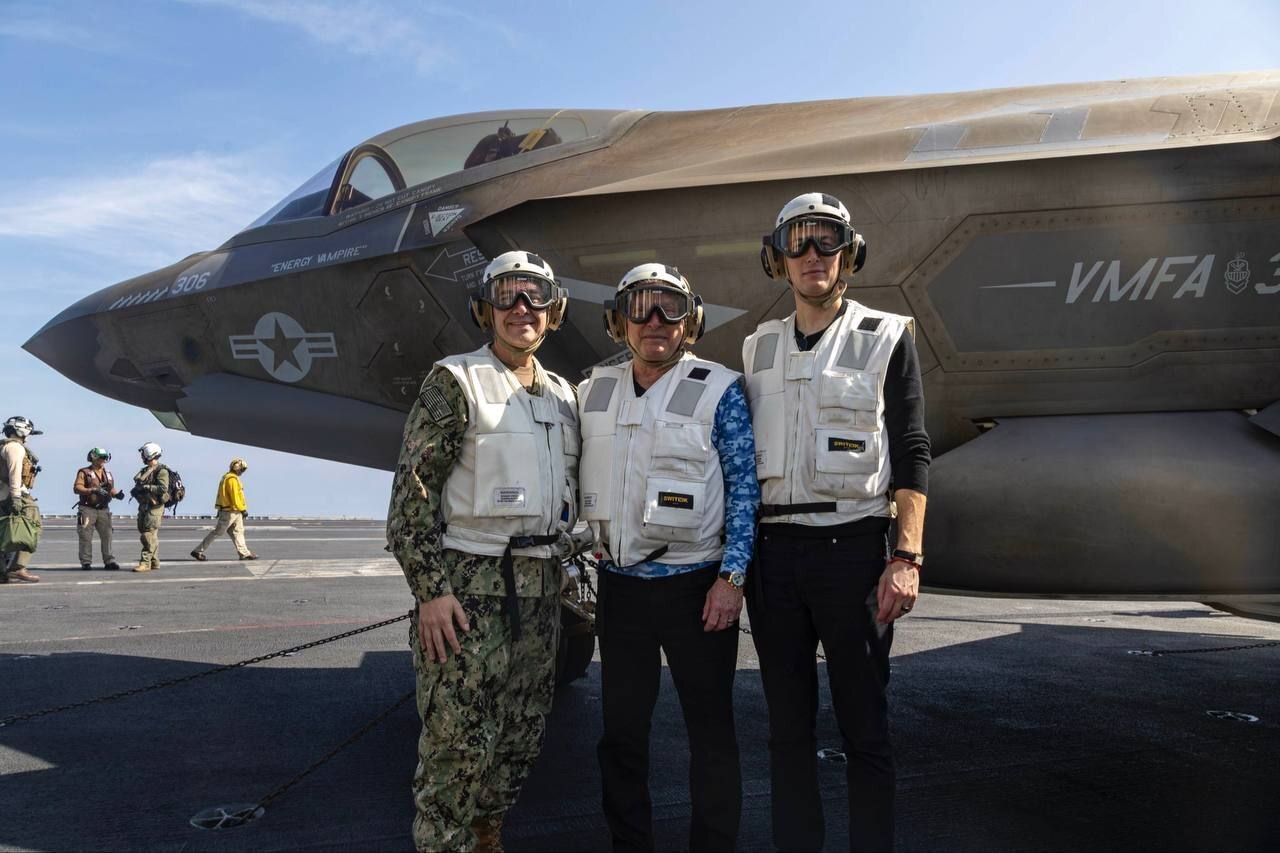
According to the U.S. Central Command (CENTCOM), Jared Kushner, senior advisor and son-in-law of President Donald Trump, along with Steve Witkoff, Special Envoy for Peace Missions, conducted a highly symbolic visit to the nuclear-powered aircraft carrier USS Abraham Lincoln (CVN-72) in the Arabian Sea on Saturday, February 7, 2026. The visit took place in the company of Adm.
Kabul 24: Brad Cooper, Commander of U.S. Central Command.This field visit occurred just one day after the conclusion of a new round of indirect negotiations between U.S. and Iranian representatives in Muscat, Oman.
Multiple U.S. media outlets—including CNN, Fox News, and Axios—described the timing as deliberate, interpreting the move as a clear demonstration of President Trump’s “peace through strength” doctrine and a reminder that military options remain very much on the table should diplomacy fail.
The Abraham Lincoln Carrier Strike Group, which departed San Diego in November 2025 and arrived in the U.S. 5th Fleet area of responsibility (including the Arabian Sea and Persian Gulf) in January 2026, plays a central role in Pentagon contingency planning for the Middle East.
Equipped with Carrier Air Wing 9, destroyers, cruisers, and advanced surveillance and strike capabilities, the carrier enables rapid power projection and can cover key targets across the region, including in Iran, within hours.During the visit, Kushner and Witkoff met with sailors, aviators, and Marines aboard the ship and its strike group.
They observed flight operations, toured key areas, and conveyed the administration’s gratitude to the deployed forces.
In a post on social media, Steve Witkoff stated: “Today we met with the brave sailors and Marines aboard the USS Abraham Lincoln, her strike group, and Carrier Air Wing 9 who are keeping us safe and upholding President Trump’s message of peace through strength.”The Oman talks—mediated indirectly and described by President Trump as “very good”—focused on Iran’s nuclear program, ballistic missile development, and regional proxy activities.
While the Pentagon officially framed the carrier visit as a routine morale and appreciation trip arranged by CENTCOM, the precise one-day sequencing after the diplomatic round has fueled widespread analysis.
Iranian state media and regional commentators labeled it a “hostile gesture” and “direct warning” to Tehran, especially given the carrier’s strategic positioning in waters adjacent to Iranian territory.This development underscores the dual-track approach of the current U.S. administration: keeping diplomatic channels open while visibly reinforcing military deterrence.
The presence of high-level civilian envoys alongside the CENTCOM commander aboard one of America’s most powerful forward-deployed assets sends a unambiguous message—that negotiations are preferred, but credible military alternatives are actively maintained and ready.