
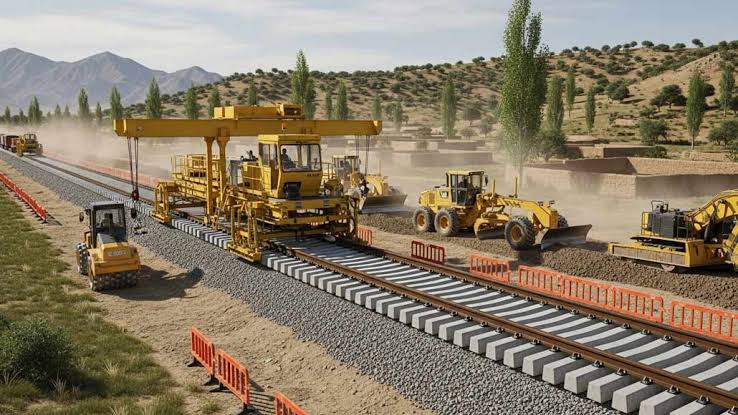
Senior officials from Kazakhstan and Germany have held diplomatic discussions in Astana regarding the expansion of bilateral economic cooperation, attraction of foreign investments, and the establishment of new transit corridors, specifically focusing on a trans-Afghan railway extending into Pakistan.
Kabul 24: The high-level meeting between Serik Zhumangarin, Deputy Prime Minister and Minister of National Economy of Kazakhstan, and Heike Peitsch, Germany’s Ambassador to Kazakhstan, underscored the potential of leveraging Afghanistan’s rail infrastructure to interconnect Central and South Asian markets. Reacting to these diplomatic engagements, Ashraf Haqshanas, Spokesperson for the Ministry of Public Works of the Islamic Emirate, stated that in line with its economy-centric policies, the caretaker government strongly supports the development of regional rail networks and stands fully prepared to facilitate the creation of new transit routes.
Currently connected to Central Asian nations through the Hairatan, Aquina, and Torghundi rail links, and to Iran via the Khaf–Herat line, Afghanistan aims to further leverage these border corridors to enhance national transit capacity and streamline cross-border trade. Concurrently, Kazakhstan, Uzbekistan, and the United Arab Emirates have signed a trilateral memorandum of understanding to assess a comprehensive rail corridor that originates in Kazakhstan, passes through Uzbekistan and Afghanistan, and reaches Pakistan’s maritime ports, effectively linking landlocked Central Asia to open international waters.
From an analytical standpoint, the joint interest from major European economic players such as Germany alongside key Central Asian nations reinforces Afghanistan’s emerging geo-economic position as a vital land bridge bridging two major economic regions. Germany’s engagement in evaluating this transit route demonstrates that despite complex geopolitical dynamics, regional economic imperatives for cost-effective and secure trade channels continue to drive infrastructure initiatives.
Furthermore, the active involvement of the United Arab Emirates alongside regional partners significantly enhances the feasibility of funding and constructing this multi-country rail link. If fully realized, this project will not only mitigate Afghanistan’s geographical isolation but also transition its economic reliance from traditional road toll revenues toward long-term, sustainable rail transit earnings.