
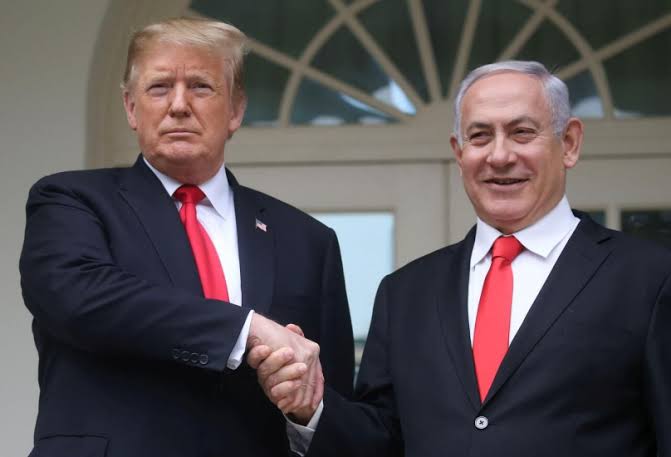
Donald Trump began the new Gregorian year alongside Netanyahu—a man wanted internationally and one of the world’s most notorious leaders, whose entry into many countries risks arrest. Yet he remains the closest ally and most intimate friend of the U.S. President.
Kabul 24: This is not merely a blatant snub to the International Criminal Court and international humanitarian law, but a serious sign of the plowing under of the liberal order established after World War II.
After 80 years, leaders of Western liberal democracies are no longer considered friends, allies of the U.S. President, or special guests at the White House.On the contrary, Trump misses no opportunity to praise “Bibi,” Putin, and Erdogan. Prime Minister Modi and President Xi have temporarily fallen off the list, but it is likely they will soon be added.
It is not hard to discern that Trump wished Putin were beside Bibi as his other guest in the opening moments of the new year.Almost certainly, absent the Iran-Israel conflict, Trump would have become one of the serious admirers of Iran’s political system and would have praised its authoritarianism.
His occasional references to Iran’s inevitable greatness and grandeur somehow reveal his intentions in this regard.As a neo-isolationist, in the absence of Iran-Israel antagonism, Trump was prepared to recognize Iran as the Russia of the Middle East.
A role now primarily assigned to Israel and secondarily to Turkey.In this light, 2026 will almost certainly be a turning point in world history.The fate of two major cases from the year ahead—namely Iran and Ukraine—will largely be determined.Ukraine, under Trump’s pressure, has agreed to cede 20 percent of its territory to Russia.
This is the first time in eighty years that the United States, as the architect and defender of the global order favoring the territorial integrity of nations, has acquiesced to border changes through force.
The second case is Iran, where Trump, encouraged by Bibi, has placed harsh conditions before it—conditions that effectively amount to violating its national sovereignty and close the door on negotiations for the authorities.
Nearly all experts agree that the current global order has reached a deadlock, and we must await the birth of a new one.In this context, Iran and Ukraine can be counted among the first victims of this transformation—two countries with differing, perhaps opposing, political orientations: Iran allied with the East, and Ukraine supported by the West.
Ukraine’s mistake was over-relying on Europe and miscalculating its current position in global politics and economics.Iran, while having fewer analytical errors, was imprecise in its conclusions.
It somewhat recognized the aforementioned developments: Europe’s decline and China’s rise. But the error was generalizing Europe’s diminished importance to the entire West, including the United States and Israel.
The United States remains the world’s largest economy and possesses the most powerful military. Israel, aside from the erosion of its soft power, has grown stronger economically and militarily compared to the past.During transitions in the international system, countries must beware of falling into the security pitfalls of the transitional era.
For example, Iraq in 1990 fell into the security hole of the shift from a bipolar to a unipolar order.The issue is not merely a potential swap of Iran and Ukraine in a grand East-West game, but a macro transformation in the global system and shifts in political equations and centers of power. Iran must be very cautious in 2026.
Salah al-Din Khodio