

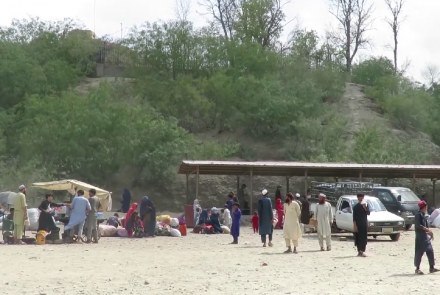
For decades, Pakistan has served as a land of refuge and transit for millions of Afghan citizens, offering hope for safety, employment, and a brighter future.
Kabul 24: However, in recent years, this hope has turned into deep anxiety, uncertainty, and fear of arbitrary arrest and forced deportation—a fear that intensifies with each passing day.Many Afghan migrants report a sharp increase in mistreatment by Pakistani police in recent months, with arbitrary detentions becoming a routine part of daily life. Some say they no longer dare to leave their homes freely.
Zahir Bahand, a journalist based in Pakistan, describes the dire situation: “Afghan refugees are trapped in their homes and only venture out under the cover of darkness at night to buy food and essentials.
The main problems for Afghan refugees in Pakistan are the lack of proper shelter and the non-renewal of visas.”Meanwhile, the Afghan Islamic Emirate’s embassy in Islamabad states that the deportation process now includes even holders of Proof of Registration (PoR) cards. Embassy officials say efforts to negotiate with Pakistani authorities to address the migrants’ issues are ongoing.
Sardar Ahmad Shakib, the Afghan Islamic Emirate’s ambassador in Islamabad, stated: “Pakistan has declared PoR card holders illegal, and their cards have not been renewed. The deportation process for them has begun, and many Afghans have been forced to return ‘voluntarily.’ However, their businesses and entire lives have been severely damaged.”On the other hand, migrant rights activists criticize the politicization of the migration issue.
They stress that migration is a humanitarian and human rights matter and should not be used as a tool in political games.
Nawid Daneshyar, a university professor and migrant rights activist, adds: “Migration is a human issue, but unfortunately, we see governments—including Pakistan, Iran, and even the United States—exploiting the vulnerable situation of Afghan migrants for political gain.”This comes as the United Nations High Commissioner for Refugees (UNHCR) previously reported that nearly two million Afghan migrants currently live in Pakistan. Many face an uncertain future, caught between the fear of detention and the dread of forced expulsion.
As of early 2026, deportations continue under Pakistan’s Illegal Foreigners Repatriation Plan (initiated in 2023 and expanded in 2025), affecting undocumented Afghans, Afghan Citizen Card (ACC) holders, and now PoR cardholders whose registrations were not extended beyond June 2025.
Reports from UNHCR and rights groups highlight ongoing arbitrary arrests, harassment, restricted access to healthcare and education, and a humanitarian crisis exacerbated by winter conditions.
Over 1.4 million Afghans have returned (many forcibly) since late 2023, straining Afghanistan’s fragile resources while leaving families in limbo.