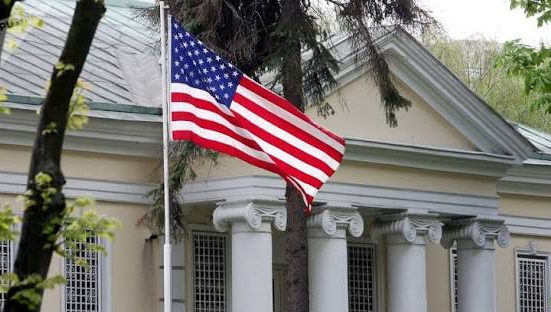

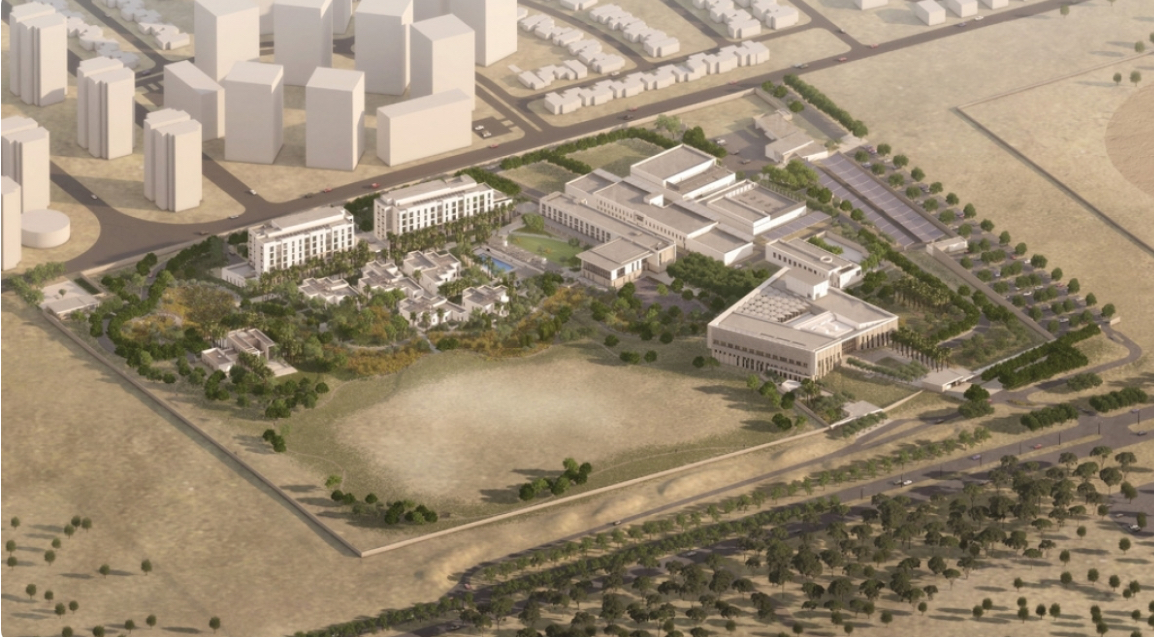
Today, American officials joined Kurdish leaders in Erbil, the capital of the Kurdistan Region, to inaugurate the largest U.S. consulate in the world. The visible joy of the Kurdish leaders was most vividly reflected in the words of Masrour Barzani.
Kabul 24: He said: “This massive twenty-hectare complex is like a great rock that will never tremble.” The intended meaning was clear: hope for an unbreakable and enduring relationship between the Kurds and the world’s greatest power.It is worth noting that the largest U.S. embassy in the world, covering 42 hectares, already sits in Baghdad.
This naturally raises the question: with such an enormous diplomatic compound just a few hundred kilometers away in Baghdad, what need was there for another twenty-hectare mission in Erbil?
The question can be posed more broadly: Iraq does not occupy the same strategic ally status for the United States as Japan in East Asia, Britain in Western Europe, or Israel in the Middle East. So why has it become such a focal point for Washington?
Perhaps because wherever the United States has intervened — even when the overall outcome has been costly and unsuccessful — it not only plans for permanent and lasting presence but also quietly nurtures a form of tutelage and silent hegemony.
This hypothesis appears to contradict the famous thesis of America withdrawing from Europe and the Middle East to focus on the Indo-Pacific in order to compete with China. Washington is not fully leaving the region; rather, it is redesigning and cost-reducing its security arrangements.
True, Trump measures everything — including the so-called endless wars — with the abacus of dollars and cents, but the strategists behind the curtain surely translate the same calculations into the language of geopolitics, strategy, and enduring influence.A few years ago, the United States had also planned to build its largest embassy in Kabul, a project that was canceled as instability intensified and the prospect of the Kabul government’s collapse became clear.
Of course, not long ago Trump himself spoke of his desire to retake Bagram Airfield, which the U.S. had equipped and rebuilt.The forty-hectare embassy in Baghdad and the twenty-hectare consulate in Erbil carry another subtle message: the United States remains committed to maintaining strategic balance between Iraq and the Kurdistan Region — a strong Kurdistan within a united Iraq! This is the formula preferred by the Americans. It naturally does not fully align with the views of some Kurds who wish to see an independent Kurdistan, nor with certain Iraqi factions that take a purely “provincial” view of the Region. Yet it bears striking similarities to America’s commitment to the “One China” policy while preserving its long-standing political and military alliance with Taiwan.
In this light, Erbil, like Taipei, belongs to that category of capitals that lack formal diplomatic recognition yet possess undeniable strategic importance.To this framework must be added the American perception that the Kurds are loyal and resolute allies, with little doubt about any long-term shift in their political orientation.
The issue is straightforward: an old and rigid geopolitical structure persists. Iran, Turkey, Iraq, and Syria are all opposed to the prominence of the Kurdish issue and the growth of Kurdish political agency. This equation ensures that the Kurds will always seek the support of extra-regional great powers and look for breathing space and escape routes.
Thus, even if the current ideological model were to change one day — say, an Islamist party were to take power in Erbil — the underlying geopolitical framework would remain unchanged. In other words, even an Islamic government in the Kurdistan Region would still orient its political compass toward Washington and nowhere else.As noted, the visible jubilation of the Barzanis — beyond the potential political significance of today’s event — has deep roots in historical psychology.
From the advent of the modern nation-state system in the Middle East, Kurds have been ignored both by dominant powers and by the regional states that contain Kurdish minorities.
One could say that for the past 150 years, direct and unmediated contact with the architects of the international order has been the dream of every Kurdish leader — a dream that remained unfulfilled until the final decades of the last century, and which only in the past two decades has taken concrete form, first in Iraq and then in Syria.From the Kurdish perspective — having been expelled from history at critical junctures such as the Sykes-Picot Agreement and the post-World War II restructuring of the international order — current developments represent rare and dreamlike opportunities.
It is true that alliance with America is like a bride with a thousand suitors, and its most recent partner was once a jihadi named Ahmad al-Sharaa. Yet the investment of nearly one billion U.S. dollars to establish a diplomatic city in the capital of the Kurdistan Region means institutionalizing this bond.
For the Kurds, this is a reassuring transformation that signals the continued existence of the autonomous Kurdistan Region.
Salahuddin Khadiv