

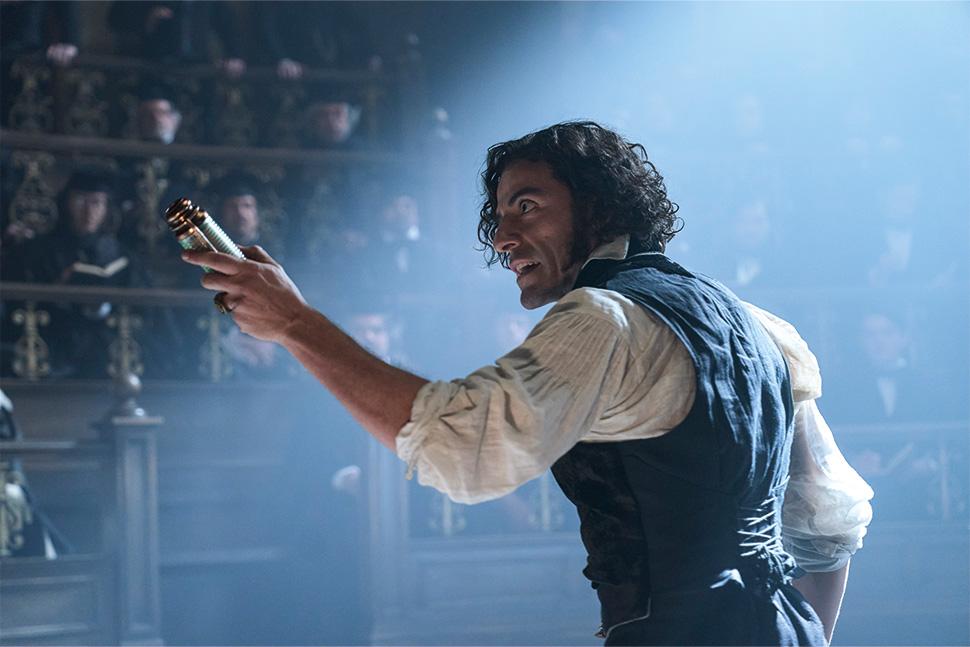
In Guillermo del Toro’s Frankenstein, an ancient legend awakens with a new face—a corpse that slumbered for centuries in the soil of imagination now opens its eyes in cinema.
This is no longer merely the tale of crafting a being from the dead; it is a mirror to the anguish of contemporary humanity.
Kabul 24: the post-human era, where man wanders lost between creator and created. Del Toro, like a poetic alchemist, extracts a philosophical essence from the Gothic genre and re-asks an eternal question: Who are we? And if we are creators, what sin have we committed against our creation—or what duty do we bear?
Victor Frankenstein, the restless scientist, steps into the realm of gods in his desire to conquer death; he seeks dominion over creation. Yet the moment his creature draws breath, meaning dies.
His creation, far from a monument to power, becomes a mirror of human frailty—a mirror in which the creator beholds the wound of his own face.
In this mirror, creator and creature become one another: both alone, both outcast, both ensnared in the sin of creation. The creator flees responsibility; the creature, in pain from immortality, seeks meaning:Pity not the one who leaves the world;
Pity the one who emerges from the realm of non-being.In this tragic embrace, del Toro sings a lament of humanity’s fall into the trap of creation.
Man, chasing eternity, empties himself of love and lays himself in a coffin of pride. From an existentialist lens, Frankenstein is the saga of man’s journey from certainty to anxiety.
The laboratory creature, pieced together from scraps of corpses, is meaningless at the moment of birth—empty, defenseless. It asks its creator: Who am I? Why am I alive?
And the echo of this cry resounds in Frankenstein’s heart, for every question from the creature is, in truth, the creator’s confession to the absurdity he finds in himself and his work after every act of creation.
Here, loneliness knows no bounds: the creator is severed from the creature, the creature from the world. Both dwell in eternal exile—one from humanity, the other from self. The film, in its hidden layers, is an elegy for the ethics of creation.
Del Toro, perhaps gazing at today’s world of artificial intelligence and cyborgs (half-human, half-machine), warns: “To create without responsibility is to destroy.” A creator who gives birth but does not nurture is a loveless god—capable of making, incapable of staying.
Power without emotion, in del Toro’s world, is a blind, heartless, godless monster—one that devours both creature and creator, leaving neither to survive with meaning.In the final act, creator and creature stare at each other in a lightless, meaningless void; gazes from which faith and certainty have fled.
Authority fades, and the wound remains—a wound with neither cure nor end.And perhaps this is the truth of life: as Milan Kundera says, “Life is carrying one’s own wound through the world.” Del Toro, without uttering it, paints the same: to live is to accept the wound, not deny it; to create is to bear the burden of the created; to be human is to stand in the purgatory between darkness and light, pain and meaning, creator and creature—a purgatory called life.