
Thanks to social media, free from government suppression and censorship, news of officials’ corruption and the luxurious lifestyles of their children was constantly shared and reposted
1 What was the main cause of the Monday uprising?
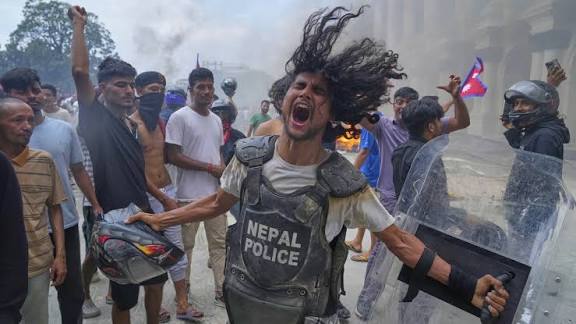
Kabul 24: Public anger erupted after the government’s decision to ban 26 popular social media platforms, including WhatsApp, Instagram, Facebook, and YouTube. Telegram had already been filtered earlier. These new restrictions brought young people and Generation Z to the streets.
For young people who essentially do not remember a time before the internet, social media is a part of personal freedoms, and their absence is considered an unacceptable violation of basic rights—an issue beyond the comprehension of the aged and outdated leadership.
2. Why did the government ban social media?With a per capita income of $1,300, Nepal is one of the poorest countries in the world, suffering from rampant corruption and mismanagement.
Thanks to social media, free from government suppression and censorship, news of officials’ corruption and the luxurious lifestyles of their children was constantly shared and reposted.
Numerous corruption cases were exposed, and extensive legal cases were filed, but the systemic corruption within the government prevented almost any of them from reaching a conclusion. This fueled public anger, waiting for a spark to explode.
3. Why did the government collapse so easily?As mentioned, the government was fundamentally inefficient and lacked legitimacy. Over the past 14 years, a corrupt, elderly troika controlled Nepal’s administration.
Oli, Deuba, and Dahal, in a rotating manner, formed the government twelve times over fourteen years.
In the eyes of the majority, their governance epitomized stagnation, inefficiency, corruption, nepotism, and failure to build a better future.
The overthrow of governments in Sri Lanka and Bangladesh through popular uprisings in 2022 and 2024 served as inspiration and motivation for the people of Nepal.
4. What is Nepal’s political system?Throughout its history, Nepal had a monarchical system, but in 2008, following a civil war, it officially became a republic. The Federal Democratic Republic with a multi-party system is the official name of Nepal’s government.
However, since the substance of governance always matters more than its form, Nepal’s republic does not truly represent the people’s sovereignty over their destiny.
The most fitting description for such governments is kleptocracy, meaning rule by thieves.
Nepal was a kleptocratic republic, similar to Russia, Serbia, Iraq, Egypt, and to some extent India, China, and Turkey.
Kleptocratic regimes are typically successors of ideological systems, composed of corrupt elites.
In such systems, politics becomes a form of personal business, and right-wing and nationalist tendencies serve to cover up the corruption of officials.
5. Who was the leader of the protesters?Like many postmodern revolutions of the past quarter-century, the protests lacked a recognized leader. However, young people aged 13 to 26, known as Generation Z, were the main activists.
The deposed king had also issued calls from exile in recent months.
Unlike velvet revolutions, the level of violence was not insignificant, with government buildings such as the parliament and the council of ministers set ablaze. Additionally, officials’ homes, a luxury hotel, a high-end private school, and many other sites were not spared from the people’s wrath.
The anger of the youth against luxurious establishments was so intense that some citizens formed human chains to protect them.
In the hours following the government’s collapse and the flight of its officials, the army took charge of street security. Now, national dialogues are set to begin, and the young revolutionaries have agreed to join them to participate in the future government.
6. What is the role of geopolitical tensions?Nepal is a small country caught, in a sense, between two major Asian powers, China and India. Nepal’s language, culture, and historical traditions are deeply tied to India, and New Delhi considers this small country part of its strategic depth.
As China’s global influence and importance have grown, Nepal’s government has shown a willingness to expand relations with it and participate in initiatives like the Belt and Road. This could provoke displeasure and challenges from India.
Oli, the resigned prime minister, was considered pro-China, and the ousted government was a coalition of pro-China and pro-India factions. The interplay of Chinese-Indian rivalry in domestic politics created dynamics that led to short-lived, unstable governments.