
Uzbek President Shavkat Mirziyoyev has signed a decree approving a trilateral intergovernmental framework agreement to conduct a feasibility study for the Naibabad–Kharlachi section of the Trans-Afghan Railway project.
Kabul 24: The decree, signed on February 4, 2026, formalizes Uzbekistan’s participation in the joint preparatory efforts for this strategic regional infrastructure initiative.
The agreement establishes a framework for cooperation among Uzbekistan’s Ministry of Transport, Afghanistan’s Ministry of Public Works, and Pakistan’s Ministry of Railways.
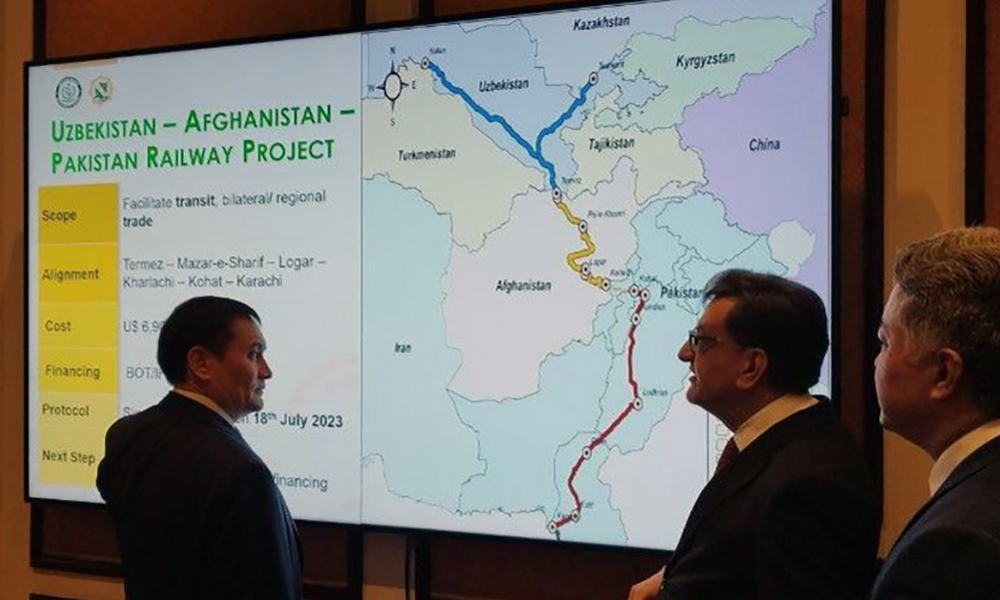
It focuses on preparing a comprehensive technical and economic feasibility study for constructing a new railway line as part of the broader Trans-Afghan corridor, which aims to connect Central Asia directly to South Asia and seaports in Pakistan.
This development builds on the original framework agreement signed in Kabul on July 17, 2025. The proposed route starts from Termez (in Uzbekistan), passes through Naibabad, Maidanshahr (Maidan Shar), Logar province in Afghanistan, and ends at Kharlachi near the Pakistan border.
The full corridor is estimated to span approximately 573 to 647 kilometers, creating a vital overland link from landlocked Central Asian countries to Pakistan’s maritime gateways, such as Karachi.
The feasibility study will be managed by the Trilateral Office for the Development Strategy of International Transport Corridors, established under Uzbekistan Railways in Tashkent in 2023, with branches already operating in Kabul and Islamabad.
First proposed in 2018, the Trans-Afghan Railway has seen ongoing discussions among the three countries. Recent cost estimates place the total project at between $7 and $8.2 billion.
One potential implementation model involves public-private partnerships under the Build-Operate-Transfer (BOT) scheme.Upon successful completion of studies and securing funding, the railway could dramatically reduce transit times for goods—from around 35 days via current routes to just 3–5 days—while handling up to 20 million tons of cargo annually.
This would significantly enhance regional trade, logistics efficiency, and economic integration between Central Asia and South Asia.Despite the progress, full realization depends on factors such as route security, political stability in Afghanistan, and attracting sufficient international investment.
Uzbekistan’s ratification marks a concrete step forward in advancing one of the most promising trans-regional transport projects in Eurasia.