
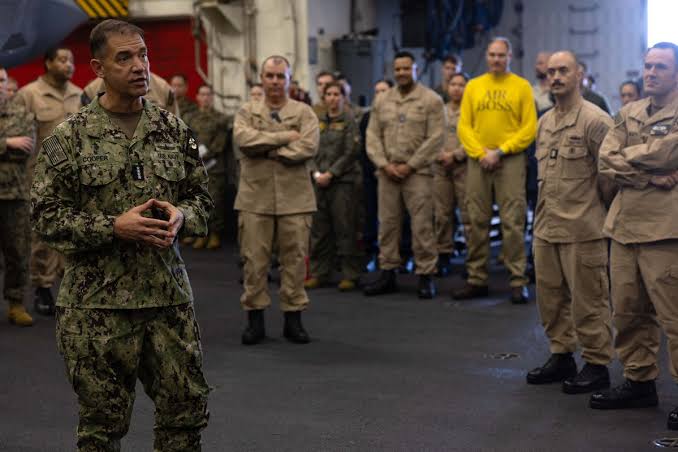
U.S. Central Command (CENTCOM) Commander visited the Middle East on Saturday and met with Marines and sailors aboard the USS Tripoli in the Arabian Sea.
Kabul 24: The visit comes at a time of heightened regional tensions, as Washington continues to weigh military options against Iran.CENTCOM released official images of the visit, showing General Brad Cooper engaging with service members deployed on the amphibious assault ship.
The USS Tripoli, a versatile naval asset capable of supporting air operations, troop movements, and expeditionary missions, is strategically positioned in the Arabian Sea, a critical waterway for global energy security and maritime trade.
This trip follows a significant Thursday meeting in which General Cooper presented Donald Trump with various military options for resuming strikes against Iranian targets.
According to sources, the briefing included a range of scenarios from limited targeted operations to more extensive campaigns. On Saturday, Trump publicly stated that the possibility of restarting attacks remains on the table, signaling a firm stance on deterring Iranian activities in the region.
Analysts view the commander’s rapid deployment visit and Trump’s comments as a coordinated show of readiness. The presence of the USS Tripoli underscores America’s ability to project power quickly in the Gulf region and surrounding waters.
The ship’s advanced capabilities provide critical support for potential operations near the Strait of Hormuz, one of the world’s most vital chokepoints for oil transport.
The Arabian Sea serves as a key corridor for commercial shipping and energy exports. Any escalation here could disrupt global supply chains and drive up oil prices. U.S. officials have repeatedly stressed the importance of maintaining freedom of navigation in these waters, with forward-deployed naval forces serving as a cornerstone of that policy.
Visits by senior commanders like General Cooper are often conducted to assess troop morale, operational readiness, and equipment status during sensitive periods.
In this case, the timing suggests alignment between political-level discussions in Washington and on-the-ground military posture in the theater.U.S.-Iran relations remain strained following previous rounds of direct and proxy confrontations.
Both sides have reinforced their military presence in recent months. Trump’s indication of possible renewed strikes has raised concerns about a return to direct conflict, especially amid ongoing regional instability involving Iranian-backed groups.
CENTCOM plays a central role in executing U.S. defense policy across the Middle East. The commander’s engagement with sailors and Marines aboard the USS Tripoli highlights the operational focus on maintaining deterrence and rapid response capabilities.
As developments unfold, the White House and Pentagon appear to be balancing diplomatic channels with robust military preparedness.
The combination of high-level strategic briefings and visible forward presence sends a clear message: the United States is closely monitoring the situation and stands ready to act if necessary to protect its interests and allies in the region.