
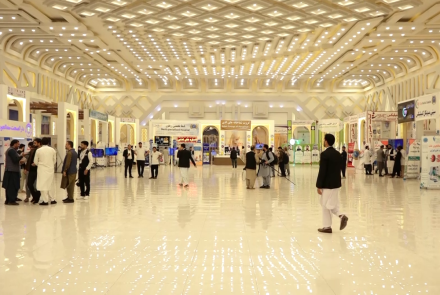
In a meeting held on the occasion of the opening of the second four-day National and International Abu Ali Sina Balkhi Exhibition in Kabul, the economic and administrative deputy prime ministers expressed satisfaction with the growth and progress of Afghanistan’s pharmaceutical industry and stressed the need for further standardization of factories and increasing production volume.
Kabul 24: Mullah Abdul Ghani Baradar, Economic Deputy Prime Minister of the Islamic Emirate of Afghanistan, stated that the Islamic Emirate is not only focused on the domestic economy but seeks clearer relations with countries around the world to achieve regional and global economic connectivity.
He assured full support from the Islamic Emirate for the private sector, investors, and industrialists, and called on Afghan specialists living abroad to support the country’s health sector.
Abdul Salam Hanafi, Administrative Deputy Prime Minister, urged all manufacturers, especially those producing medicines and medical products, to pay special attention to quality. “Our demand from all producers is to give particular attention to the quality of their products,” he said.
Meanwhile, Noor Jalal Jalali, Minister of Public Health of the Islamic Emirate of Afghanistan, spoke about the pharmaceutical industry approaching self-sufficiency and called on citizens and doctors to strengthen and use domestic products.
He noted: “Medicines used to be imported from a country that thought creating problems for us would put us in serious trouble in the pharmaceutical sector.
But we found other ways, and now the most important thing is to use and strengthen domestic production.”Hamidullah Zahed, Deputy Minister for Medicines and Food at the Ministry of Public Health, said: “We must turn trade into industry.
The raw materials for 4,500 types of medicines exist right here in our own land.”Ahmadullah Zahed, Deputy Minister of Industry and Commerce, announced that any investor who invests in a new sector where no previous investment has been made will enjoy five years of tax exemption.
On the other side, Ahmad Saeed Shams, President of the Union of Medicines and Medical Products, reported the activity of 130 pharmaceutical and health product factories worth $450 million in the country.
He stated that currently 1,170 types of medicines and health products have been registered in Afghanistan, with nearly 500 more under review.
These products now meet approximately 38% of the country’s needs.Shams added: “Eight months ago, we could meet 25% of the country’s needs with these 135 factories.
According to our latest assessment, this figure has now reached 38% in the past eight months.”More than 100 pavilions have been dedicated to displaying medicines and health products during the four-day exhibition.
This event serves as an important platform to showcase the achievements of Afghanistan’s pharmaceutical industry, attract new investments, and build greater public confidence in domestically produced medicines.