

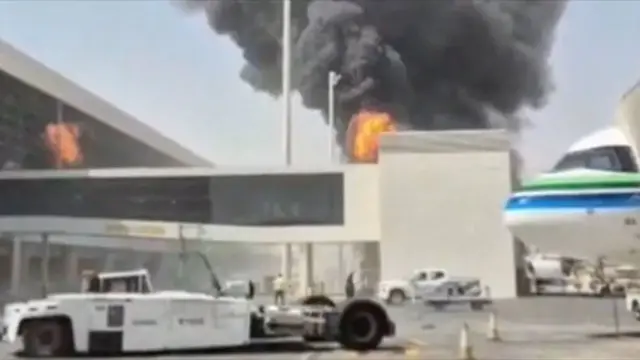
With recent Houthi attacks on Saudi airports—particularly King Khalid International Airport in Riyadh—civil aviation has turned into a major arena for escalating regional tensions. These strikes have resulted in civilian casualties and disrupted operations at one of the region’s most vital airports.
Kabul 24: When viewed alongside Mohsen Rezaee’s threats from previous weeks, the strategic significance of these developments becomes even more pronounced. Rezaee had warned that if regional countries cooperated with the U.S. in implementing flight restrictions against Iran, their airports would also cease operations. Now, at least part of that threat has materialized.
Nevertheless, the concurrence of these events shows that aviation infrastructure, much like maritime transport, has transformed into yet another tool for pressure and retaliation in the regional conflict.
The significance of the matter extends far beyond damage to a single airport. If the Houthis’ recent threat against Qatar materializes—potentially targeting Doha’s Hamad International Airport, a primary hub for passenger and cargo transit—this escalation will take on deeply dangerous dimensions.
Major hubs like Riyadh, Doha, and Dubai are critical nodes in the regional flight network. Prolonged insecurity and disruption in their operations could reroute flight paths, inflate transportation costs, and trigger a cascading wave of delays and cancellations worldwide.
If the threats against Doha’s Hamad Airport ever translate into a real attack, the repercussions—akin to a fuel price shock—could easily cross national borders and morph into a global crisis.
However, have we entered a brand-new phase of war between Iran, the U.S., and Israel with the onset of an “Airport War”? There is still insufficient evidence to draw such a conclusion. Houthi attacks must first be analyzed within the context of the ongoing war in Yemen and the group’s confrontation with Saudi Arabia. At the same time, expanding targets from waterways and energy infrastructure to airports elevates the risk of interwoven war fronts—a process that appears to be unfolding rapidly, moving from waterways to airports, and potentially, in more intensified stages, to land and rail transport corridors.
The core question is whether these strikes will remain limited or trigger a broader military response from Saudi Arabia, more direct U.S. intervention, and an expansion of target scopes. In the latter scenario, airports would no longer be isolated targets; instead, they would become part of a sweeping battle over regional connectivity, trade, and operational capabilities.
While the “Airport War” may not yet be a firmly established phase of warfare, it serves as an alarming warning sign regarding the expanding vulnerability of the region’s critical infrastructure.
The war in Yemen has effectively evolved into one of the major arenas of confrontation between Iran and the U.S., turning the fate of Bab-el-Mandeb and the struggle for its control into another layer of the ongoing conflict.
Salaheddin Khadiv