
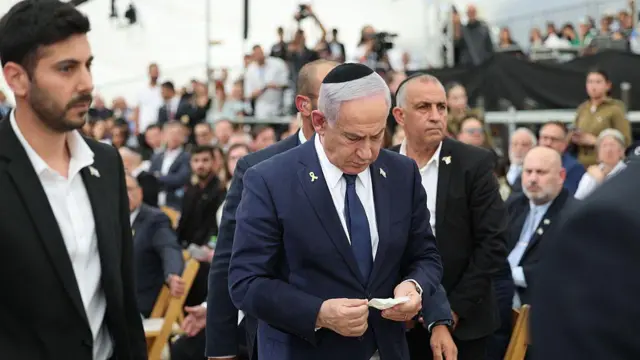
From the crucible of the Israeli election emerges a weakened yet resilient and determined Netanyahu. The opposition managed to challenge him, but apparently cannot easily unseat him from power. Bibi has also received a heavy blow from Israeli Arabs—the 1948 Palestinians; yet, without being knocked down, he remains standing in the arena.
Kabul 24: Israel’s wounded wolf now faces two fundamental issues: maintaining power and securing a lasting historical legacy ahead of political retirement, which will come sooner or later. A politician who is injured yet retains the strength to endure may resort to riskier behaviors to survive and compensate for his setbacks. For this reason, one must seriously consider the probability that Netanyahu will act more boldly and aggressively regarding the Iran file than in the past. A nationalist and hawkish foreign policy, especially under domestic crisis, can serve as a tool to shift the political agenda, mobilize public opinion, and escape internal pressure.
The election results have made coalition building exceptionally difficult. Neither of the opposing camps appears to have a smooth path toward forming a government without securing the support of Arab party lists—an option that seems highly unlikely under current political conditions. Another path is a power-sharing agreement between the two rival camps, dividing the prime minister’s tenure into two two-year terms.
Should such an agreement materialize, Netanyahu may hold a stronger position to serve as prime minister for the first two years. Support from Donald Trump, combined with the continuation of the war and the dominance of security priorities, could work to his advantage and reinforce the arguments of those advocating for his continued leadership.
A third scenario is persistent political deadlock leading to snap Knesset elections. In this case as well, Netanyahu would remain in power until a new government is formed, potentially leaning further into displays of military strength and escalating external confrontation to boost his electoral prospects.
Under all three scenarios, Netanyahu’s political incentives to leverage the Iran file could remain intact—though the intensity and direction of these motives will depend on field developments, security calculations, and domestic constraints. From this angle, the risk of escalating confrontation with Iran must be monitored more seriously than before.
On the other side, the U.S. midterm elections could also impact this equation. While the mechanisms of American domestic politics differ from those of Israel, Trump’s approach to a critical juncture in his own political lifespan—much like Netanyahu—could alter his calculations regarding Iran. If he perceives that little time remains to achieve his regional objectives, he might turn to higher-risk maneuvers, particularly if he believes a military confrontation could shape his political legacy or cement his place in history.
The core issue lies in the interplay between the political motives of Washington and Tel Aviv with regional military and diplomatic developments.
Overall, what appears concerning is the convergence of two trends: a Netanyahu who requires fresh incentives to retain power and rebuild his standing, and a Trump who, at a critical moment in his political career, may seek a major foreign policy breakthrough.
The intersection of these two trajectories could heighten the risk of renewed conflict against Iran; although whether this risk materializes still depends on calculations and decisions that cannot be taken as certainty. Yet one point remains clear: the outcome of the Israeli election has not dispelled the shadow of war over Iran—it may have very well intensified it.
Salahaddin Khadiv