

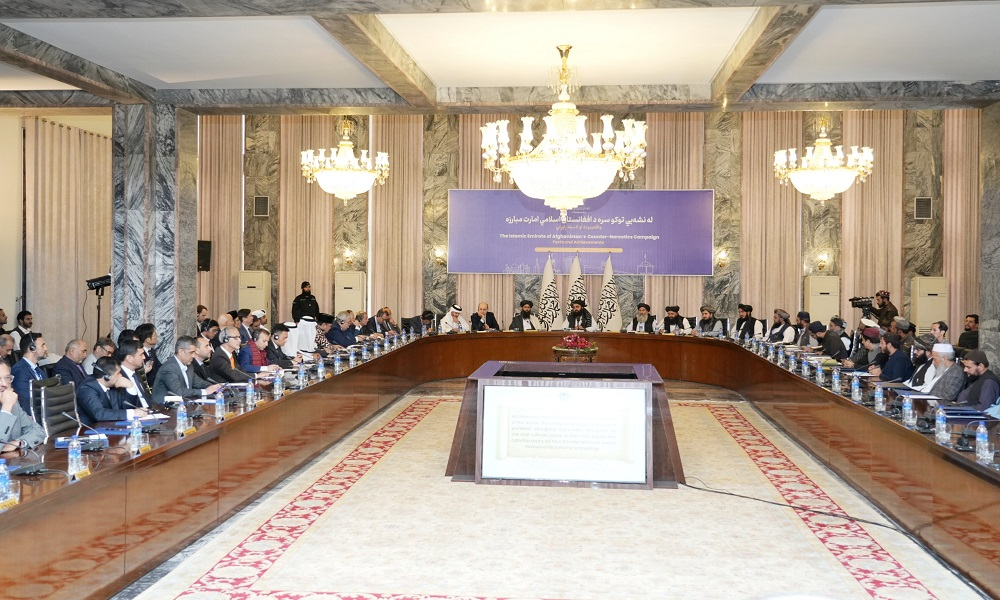
The Ministry of Foreign Affairs of Afghanistan released a report detailing a high-level conference titled “Counter-Narcotics Efforts: Realities and Achievements,” held in Kabul. Attended by senior government officials, foreign diplomats, and representatives of international organizations, the meeting reviewed key metrics and operations conducted against illicit drug production and trafficking throughout 2026.
Kabul 24: According to figures presented by Abdul Rahman Munir, Deputy Minister of Interior for Counter-Narcotics, security forces executed more than 25,000 targeted operations across the country during the year. These actions resulted in the destruction of 26,500 hectares of opium poppy and cannabis crops, alongside the arrest of 10,065 suspects. Furthermore, security personnel dismantled key production infrastructure, seizing 301 processing laboratories, two chemical tablet factories, and 15 alcohol production facilities.
Addressing the assembly, Foreign Minister Amir Khan Muttaqi reiterated that the implementation of the leadership’s decree banning the cultivation, processing, trafficking, and consumption of narcotics demonstrates a firm stance against drugs. However, Muttaqi highlighted cross-border trafficking and cultivation in neighboring countries as ongoing concerns, stating that counter-narcotics efforts cannot achieve permanent success without coordinated international cooperation.
Additionally, Mohammad Naeem, Deputy Minister of Foreign Affairs for Finance and Administration, emphasized that offering viable alternative livelihoods for farmers, funding rehabilitation centers, and fostering regional technical coordination remain critical to sustaining these results.
Editorial Analysis:
Presenting detailed counter-narcotics statistics before an international diplomatic audience highlights Kabul’s strategy to use drug enforcement achievements as a bridge for regional engagement and global diplomacy. While the reported destruction of processing facilities and crops underscores strong enforcement measures, long-term stability hinges on securing foreign technical aid and agricultural subsidies for farmers transitioning away from illicit crops. Furthermore, references to cross-border trafficking indicate that sustained progress requires a multi-lateral regional framework beyond unilateral domestic policy.