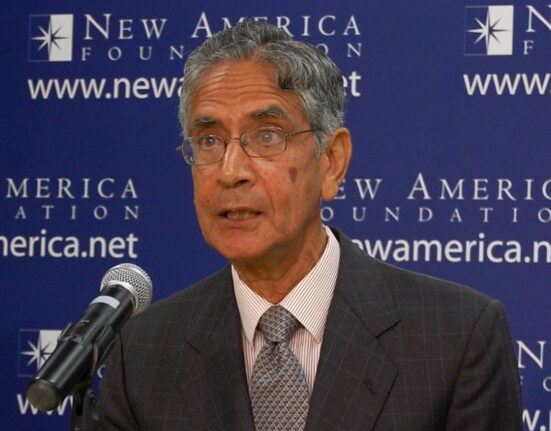


Tom Barrack, U.S. Ambassador to Turkey and the official in charge of resolving the Syria file, posted the above image with the caption: “A picture is worth a thousand words — a new beginning!”
Kabul24: The photo re-shared by the ambassador shows the meeting between Asaad al-Shaibani, Foreign Minister of the government of Ahmed al-Sharaa, and General Mazloum Abdi, the Kurdish military commander, with the U.S. Secretary of State during the Munich Security Conference.It is said that Rubio refused to meet Shaibani alone and conditioned his acceptance on the presence of the two Kurdish leaders attending the conference: Mazloum Abdi and Ilham Ahmed.
Tom Barrack, by praising this gathering, is emphasizing Washington’s policy in Syria and, more broadly, the new regional security architecture.As has been observed in recent weeks, the United States was unwilling to stand behind its Kurdish allies in Syria to preserve their extensive autonomy over thirty percent of the country’s territory, including entirely Arab-populated provinces.
This shift, while reflecting the geopolitical realities of the region, Turkey’s strong leverage, and the structural shortcomings of Syrian Kurdistan (compared to other Kurdish regions in the Middle East), also had another important reason:Washington’s exhaustion and frustration with the dysfunctional sectarian systems in Iraq and Lebanon, and especially its disappointment with the endless, tedious disputes between the two ruling parties in the Kurdistan Region.
Despite Washington’s repeated mediation efforts, the differences between these two parties have never been resolved.Both Iraq and Lebanon have been structured on the basis of a quota system. What eager minorities call “consociational democracy,” in American eyes has become a tool for turning them into Iran’s backyard and a source of potential instability.
For this reason, unlike the 1990s when the White House facilitated the creation of the Kurdistan Region, today it is thinking about strengthening existing nation-states so they can fully assume security responsibilities.
Of course, this does not mean abandoning support for the democratic integration of Kurds in Syria or preserving some cultural and administrative aspects of their autonomy under the new regime.Beyond Syria, the message of America’s new policy is clear: there is no new agenda to support ethnic and linguistic minority claims in other Middle Eastern countries, and the era of declaring no-fly zones is over.
In fact, Washington’s overall preference is to work with capitals, not with peripheral power centers that emerge from political ebbs and flows.Naturally, like any other imperial power, America first considers its own interests.
The endless entanglements in the quagmires of Iraq and Afghanistan—each filled with a multitude of sub-state actors—have left it like a snake-bitten person who fears every black and white rope.
The White House’s view is that those failed experiences were nothing but two decisive assists to Beijing.Another important point is that American and Israeli security and strategic preferences are not always aligned.
Both in the case of the 2017 Kurdistan Region referendum and in the recent developments in Syria, Tel Aviv wanted clear and effective support for the Kurds. But it faced American opposition and did not have enough independent agency to take effective action on its own
.Salahuddin Khadiv