
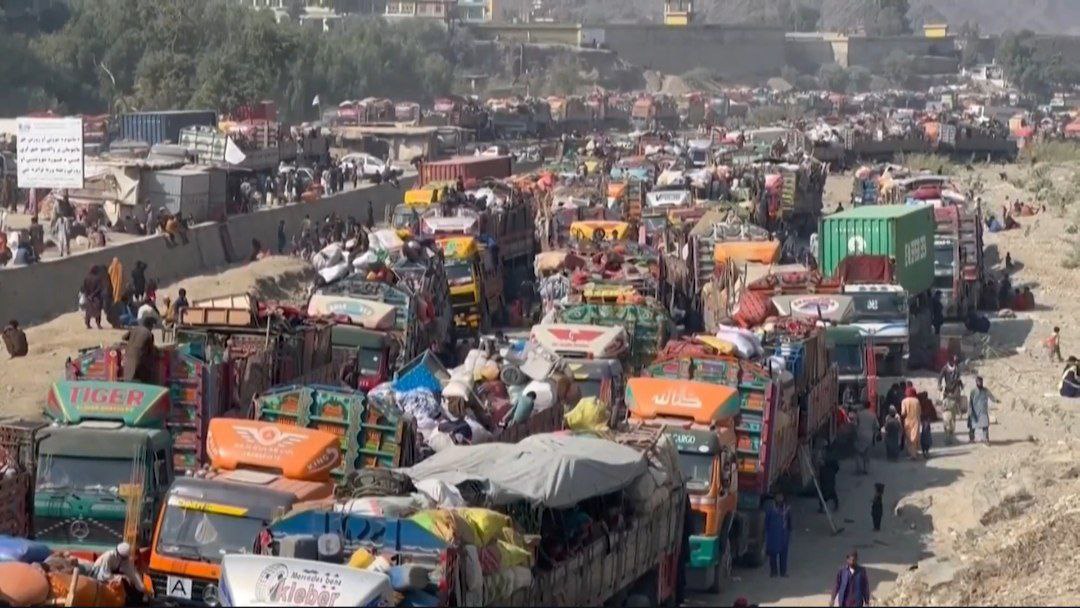
The complete closure of the Chaman and Torkham border crossings since October 12 (20 Mizan) due to escalating political tensions between Islamabad and Kabul has brought bilateral trade to a near-total halt, triggering an unprecedented economic crisis in Pakistan, particularly in its northern regions.
Kabul 24: The cement industry has suffered the heaviest blow: Afghanistan accounted for roughly 7% of Pakistan’s total cement exports. Major producers such as Cherat Cement, Fauji Cement, and Maple Leaf Cement have seen exports grind to a complete stop and sales plummet.
Simultaneously, the cutoff of Afghan coal—previously the cheapest and closest energy source for factories in Khyber Pakhtunkhwa and northern Punjab—has driven domestic coal prices from 30,000–32,000 to 42,000–45,000 Pakistani rupees per ton. Factories have been forced to import far more expensive coal from South Africa, Indonesia, and Mozambique, pushing cement production costs up by as much as 20%.The pharmaceutical sector is also in critical condition. Official drug exports to Afghanistan were worth around $187 million annually, while smuggled volumes are estimated to be three times higher.
Millions of dollars worth of pharmaceutical shipments are now stranded in factories, and certain medicines produced exclusively for the Afghan market have no domestic demand in Pakistan.
Fruit and vegetable exporters have incurred irreparable losses. Approximately $150 million worth of perishable produce was exported annually to Afghanistan and onward to Central Asia; much of it has either been dumped on the local market at rock-bottom prices or has completely spoiled.
Meanwhile, Pakistan has turned to Iran for pomegranates, grapes, and apples, causing domestic prices of these items to double.According to the Afghanistan–Pakistan Joint Chamber of Commerce, 700–750 containers are stuck at Chaman, 350–400 at Torkham, and over 9,000 containers await clearance at Karachi and Qasim ports for onward shipment to Afghanistan and Central Asia.
Exports of edible oil (6,000–8,000 tons monthly) and numerous other commodities have also ceased entirely.Pakistani experts warn that prolonged closure will not only cost the economy billions of rupees but risks permanently losing the Afghan market to regional competitors such as Iran, Russia, and Central Asian states.
Meanwhile, thousands of truck drivers stranded on both sides of the border are facing acute shortages of food, fuel, and shelter.