
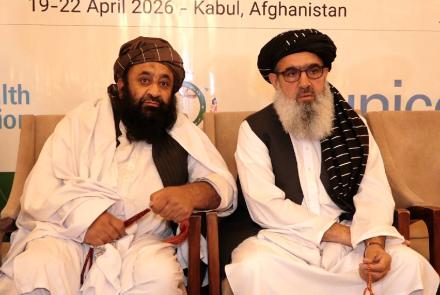
Mawlawi Noor Jalal Jalali, Minister of Public Health of the Islamic Emirate of Afghanistan, has emphasized efforts to make the country’s health system self-sufficient based on a new strategic plan.
Kabul 24: He made the remarks during a four-day coordination and capacity-building workshop for provincial health officials, organized by the Ministry of Public Health in cooperation with UNICEF and the World Health Organization (WHO).
The workshop, held in Kabul, focused on reviewing challenges, evaluating past achievements, and identifying practical solutions to enhance healthcare services across the country.
Minister Jalali strongly criticized the way budgets are spent in some provincial hospitals. He pointed out that in one southern province, more than 150 million afghanis in budget funds were returned unspent, while the ministry received complaints that even basic medical supplies, such as a single bandage, were unavailable in the provincial hospital.“Some provinces have the capacity to utilize their budgets effectively and efficiently,” the minister said. “Serious efforts must be made to ensure that every health facility under the Emirate has adequate stocks of medicines, equipment, and medical consumables.
Any problems should be reported promptly to the relevant authorities.”Jalali also stressed the need to allocate special quotas for specialist positions in underserved and remote provinces. He warned that contracts with negligent or underperforming implementing partners would be terminated.
The minister assured participants that the Ministry of Public Health is taking concrete steps under its new planning framework to achieve self-reliance in the health sector and reduce dependence on external aid.Abdul Wali Haqqani, Deputy Minister for Health Service Delivery, added that the workshop provides an opportunity to discuss service delivery, review achievements of the past five years, assess ongoing projects, and plan for the future.
The goal is to accurately evaluate the situation in each province and develop targeted solutions to overcome challenges and improve healthcare quality.Meanwhile, international partners reiterated their support.
Tajuddin Iwali, UNICEF Representative in Afghanistan, acknowledged the growing global pressure on financial resources and welcomed the ministry’s initiative to publish a national health program. “Due to increasing global needs, financial support for health is not as strong as before,” he noted. “We, as the United Nations, welcome the announcement and publication of the national health program by the Ministry of Public Health.”Dr. Khushal Zaman, WHO Representative in Afghanistan, highlighted significant progress in polio eradication.
He stated that the number of polio cases has decreased remarkably worldwide. In 2025, only a limited number of wild poliovirus type 1 (WPV1) cases were reported globally—mostly from Afghanistan and Pakistan.
He emphasized that without the global polio eradication program, millions of children could have been paralyzed. The representative called for continued joint efforts to completely eliminate the disease.
The four-day workshop served as an important platform for coordination between provincial officials, the Ministry of Public Health, and international partners.
Discussions centered on promoting self-sufficiency, ensuring transparency in budget utilization, strengthening capacity at the provincial level, and delivering higher-quality healthcare services nationwide.