
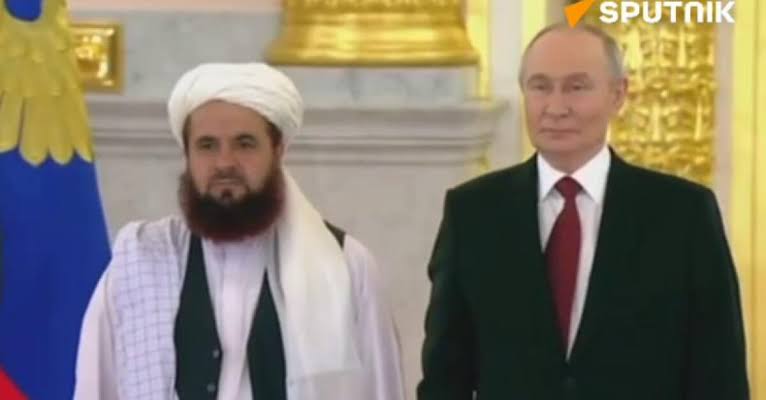
On Thursday, January 15, 2026, Russian President Vladimir Putin formally received the credentials of 34 new foreign ambassadors during a traditional ceremony held in the grand Alexander Hall of the Kremlin Palace.
kabul 24: Among the diplomats presenting their letters of credence was Gul Hassan Hassan, the newly appointed Ambassador of the Islamic Emirate of Afghanistan to the Russian Federation.
This marks the first time since the Taliban’s return to power in August 2021 that Moscow has officially accepted an ambassador representing the current Afghan authorities.
According to reports from Russian state media outlets including Sputnik, Izvestia, and RIA Novosti, the ceremony was attended by representatives from various regions, including Europe, Latin America, Asia, and Africa.
Notably, ambassadors from 11 “unfriendly” countries—such as France, Norway, Sweden, and Italy—were also present.
In brief remarks to the newly accredited diplomats, President Putin emphasized the importance of international cooperation, adherence to international law, and the pursuit of a fair, multipolar world order.
Speaking specifically about Afghanistan, he stated:“Russia is interested in seeing Afghanistan as a united, independent, peaceful country free from war, terrorism, and drug trafficking.”This statement reflects Moscow’s long-standing position that stability and security in Afghanistan serve Russia’s national interests, particularly in countering threats such as terrorism (especially from ISIS-Khorasan) and the cross-border flow of narcotics.
The acceptance of Ambassador Gul Hassan Hassan’s credentials is widely seen as a significant step in the deepening of pragmatic diplomatic, economic, and security ties between Russia and the Islamic Emirate.
Over the past few years, Moscow has gradually expanded engagement with Kabul: removing the Taliban from its list of banned terrorist organizations, appointing a special envoy for Afghanistan, opening a diplomatic mission in Kabul, and increasing trade and energy cooperation.
Gul Hassan Hassan, who previously served as the Afghanistan consul in Pakistan, now officially begins his tenure in Moscow. Analysts view this development as part of Russia’s broader strategy to strengthen influence in Central Asia, secure its southern borders, and engage constructively with the de facto authorities in Kabul amid shifting regional dynamics.
The ceremony underscores Russia’s willingness to recognize geopolitical realities on the ground and pursue practical diplomacy, even in the absence of widespread international recognition of the current Afghan government. The move is expected to pave the way for further expansion of bilateral relations in the coming months.