
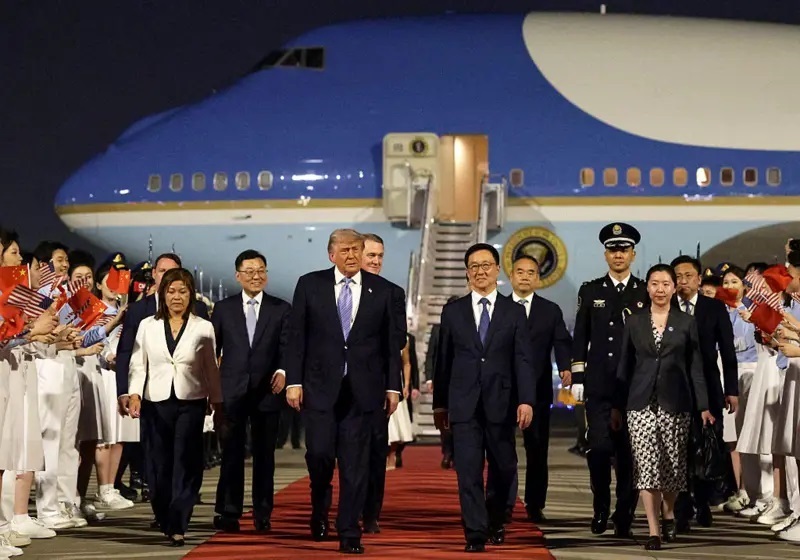
U.S. President Donald Trump, accompanied by a high-level delegation including family members, senior government officials, and figures such as Elon Musk, arrived in Beijing on Tuesday.
Kabul 24: This marks the first visit by a U.S. president to China since 2017, during Trump’s first term in office.The arrival ceremony at the airport was elaborate and meticulously planned, emphasizing the symbolic importance of the visit and bilateral relations.
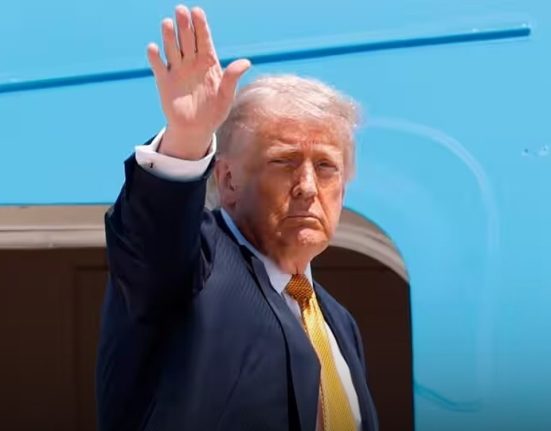
Trump stepped off Air Force One onto a red carpet as approximately 300 young Chinese people, dressed in coordinated white and light blue uniforms, lined both sides of the path, repeatedly chanting “Welcome, welcome.” A military band performed, adding to the formal and grand atmosphere.
Senior Chinese officials, including Han Zheng, Vice President of China, along with the U.S. Ambassador to China and China’s Ambassador to the United States, were present to greet the American president.
Notably, Chinese President Xi Jinping was not at the airport to welcome Trump.In Chinese diplomacy, the level of official assigned to greet a visiting leader carries a deliberate political message.
While the absence of Xi Jinping may raise questions, the choice of Vice President Han Zheng is widely viewed as a respectful, mid-level protocol decision.
According to established Chinese diplomatic practice, the President rarely goes to the airport to welcome foreign leaders, delegating the task to senior officials instead.Han Zheng’s presence is considered a positive signal.
He previously attended Trump’s second inauguration and is often assigned to high-profile ceremonial events, such as the coronation of King Charles III.
Compared to Trump’s 2017 visit, which was greeted by a lower-ranking official (Yang Jiechi at the time), the current reception represents a symbolic upgrade.
This carefully calibrated welcome appears designed to show respect and acknowledge the importance of U.S.-China relations without excessive warmth.
For Trump, who is particularly attentive to symbols of status and ceremony, the presence of a Vice President is likely to be interpreted as a gesture of esteem.The visit comes at a critical time in U.S.-China relations, which remain highly competitive yet interdependent.
Trade, technology, tariffs, regional security, and intellectual property issues are expected to dominate discussions during Trump’s stay. Analysts anticipate direct talks between Trump and Xi Jinping in the coming days.
Trump’s arrival in Beijing with such formal pomp opens a new chapter in engagement between the world’s two largest economies.
The international community is closely watching the outcomes of this high-stakes diplomatic trip, which could shape global economic and political dynamics for years to come.