
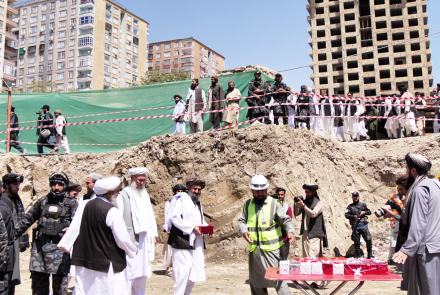
Construction work on the B4 residential complexes of the “Sulh” Housing Project in Kabul’s Fifth Macroryan area has officially begun, with the project aimed at addressing the city’s housing shortage and providing standard residential facilities.
Kabul 24: Speaking at the inauguration ceremony, Deputy Prime Minister for Economic Affairs Mullah Abdul Ghani Baradar said rapid population growth, a shortage of housing and inadequate public services remain major challenges for Kabul.
Baradar said the Islamic Emirate is committed to completing stalled development projects from the previous administration, including projects in Fifth Macroryan and New Kabul, which he said could help ease the housing shortage.
Deputy Prime Minister for Administrative Affairs Abdul Salam Hanafi said Afghanistan’s housing sector offers significant investment opportunities, noting that increased demand from returning migrants and Afghan citizens has further highlighted the need for new residential projects.
Meanwhile, Minister of Urban Development and Housing Najibullah Hayat Haqqani said providing standard housing is among the ministry’s priorities. He said efforts are underway to ensure urban development follows proper planning and construction standards.
The project is being developed on nearly 1,300 jeribs of land and is expected to accommodate around 25,000 people. It consists of 118 18-story blocks, with the first phase covering 20 residential complexes, each containing 137 housing units.
Officials said the buildings have been designed to withstand earthquakes of up to nearly magnitude 10 on the Richter scale.
Bahadir Erdogan, head of the company implementing the project, said modern construction methods are being used. He added that the first phase will create jobs for nearly 500 people, including engineers, technical personnel and workers, with 99 percent of the workforce being Afghan nationals.
The Fifth Macroryan project was launched in 1393 (2014–15) but remained stalled for 12 years. Following the resolution of outstanding issues, construction resumed in 1404 (2025–26).