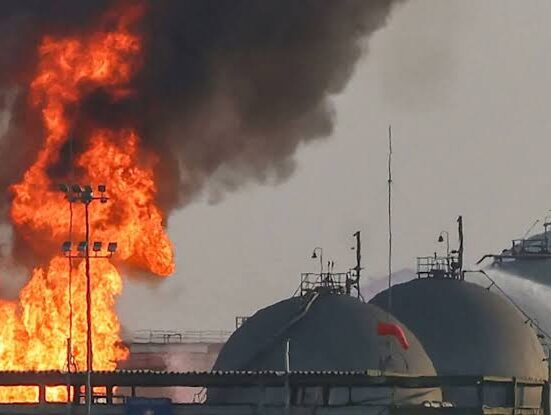


Secretary of Defense Pete Hegseth declared on Friday that the Islamic Republic of Iran continues to pose a serious threat in the Middle East, even after the large-scale U.S. and Israeli military strikes that, according to Pentagon claims, “completely destroyed” Tehran’s nuclear program in June.
Speaking to defense industry leaders in Washington on December 5, 2025, Hegseth described the June operation – codenamed Operation Midnight Hammer – as “a textbook implementation of the Weinberger Doctrine.”“With Operation Midnight Hammer, the world – after decades of hesitation – finally witnessed the decisive effect of American military power in eliminating Iran’s nuclear program,” Hegseth said.
Kabul 24: In the early hours of June 22, 2025, U.S. forces struck three key Iranian nuclear facilities: the deeply buried Fordow enrichment site, the Natanz uranium enrichment complex, and the Isfahan nuclear technology center. Seven B-2 Spirit stealth bombers dropped more than 14 GBU-57 Massive Ordnance Penetrators (bunker-busters) on Fordow and Natanz, while over 30 Tomahawk cruise missiles launched from Ohio-class submarines targeted Isfahan.
Hegseth, appointed by President Donald Trump, called the strikes “focused and precise power that advanced our national interests without dragging the United States into a prolonged war.” He explicitly invoked the Weinberger Doctrine – the strategic principles laid out in 1984 by then-Secretary of Defense Caspar Weinberger under President Ronald Reagan – designed to prevent America from becoming entangled in vague, unpopular, or open-ended conflicts following the bitter experiences of Vietnam and Lebanon.
Despite the strikes, Hegseth warned that the danger from Tehran persists. “Our European allies face the Russian threat. Iran has been pushed back by the decisive actions of President Trump and Israel, but it remains a threat in the Middle East. And of course, North Korea continues to be a source of concern on the Korean Peninsula,” he said.
The defense secretary also defended recent U.S. naval operations against suspected drug-smuggling vessels in the Pacific and Caribbean, branding the traffickers “narco-terrorists” and declaring that “their era is over.”Hegseth’s remarks come amid lingering high tensions in the region. While Israel welcomed the June strikes, the United Nations and several European allies have warned of the risk of further escalation.
The International Atomic Energy Agency (IAEA) has stated that a full damage assessment will take time, and early intelligence suggests the attacks may have only set Iran’s program back by months rather than destroying it entirely. Tehran insists its facilities were evacuated in advance and that its peaceful nuclear program will continue.