
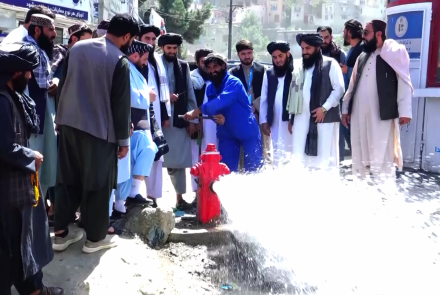
The State Urban Water Supply and Sewerage Corporation officially inaugurated a major pipeline network in Kabul today, extending from Maiwand Road to the Avicenna (Ibn Sina) Hospital.
Kabul 24: Constructed with a financial investment exceeding 28 million Afghanis funded by UNICEF, the newly operational project secures access to clean drinking water for more than 30,000 local residents.
This infrastructure expansion boosts Kabul’s daily municipal water distribution from 35,000 cubic meters to 42,000 cubic meters.
Ahmad Jan Bilal, Head of State Corporations, outlined the national distribution trajectory:
1402 (2023): 52 million cubic meters distributed nationwide1403 (2024):Increased to 55 million cubic meters
1404 (2025):Projected growth to 60 million cubic meters
1405 (2026):Targeted increase to 65 million cubic meters
Despite these infrastructure gains, water officials warn of critical groundwater depletion across the capital, urging citizens to minimize consumption. Ghulam-ur-Rahman Kazim, General Director of Urban Water Supply, noted that Lake Qargha remains Kabul’s sole surface water reservoir, while underground aquifers are rapidly drying up.
Local community leaders welcomed the project. Syed Hassan, a local representative (Wakil-e-Gozar), shared that residents in District 1 previously had water access only once a week, and the new network has resolved their immediate supply shortage.
Rapid urbanization, population growth, and dropping water tables continue to make water security one of Kabul’s most pressing challenges.
Without long-term sustainable water infrastructure, environmental reports caution that Kabul could face a catastrophic water shortage by 2030.