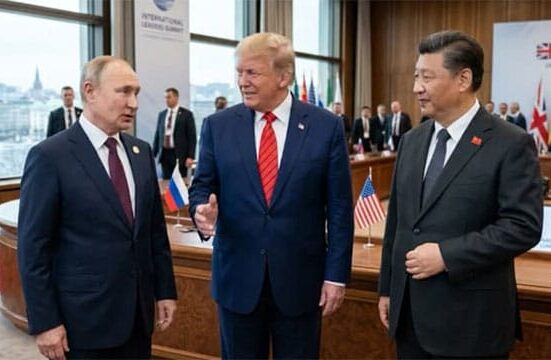


The launch of the trilateral summit between Donald Trump, Vladimir Putin, and Xi Jinping at the Qilin Villa in Shenzhen, China, on November 19 marks a pivotal moment in the international order one that simultaneously revives hopes for grand bargains and deepens anxieties over a return to “spheres of influence” politics.
Kabul 24: Although no transparent or official agenda has been announced for the meeting, its timing coinciding with escalating crises in the Middle East and the grinding attrition of the war in Ukraine signals that the leaders of the three major powers are bargaining over the world’s unresolved flashpoints, with the fates of nations like Ukraine and Iran directly tied to the outcome.
Many observers, alarmed by the prospect of the United States, Russia, and China carving up the world without Kyiv or Europe at the table, have drawn parallels to the historic Yalta Conference. From a strategic standpoint, however, likening Shenzhen to Yalta in 1945 is an analytical misreading. Yalta took place after Nazi Germany’s defeat was assured, serving as a framework to divide the spoils and establish a postwar order. Today, by contrast, no war has concluded, nor have the great powers achieved a decisive victory.
On the contrary, the conflicts in Ukraine and the military standoffs surrounding Iran have demonstrated that small and medium powers—leveraging low-cost technologies, asymmetric warfare, and geopolitical advantages can bog down major powers. Consequently, the Shenzhen summit bears far less resemblance to Yalta than it does to the 1943 Tehran Conference: a gathering convened mid-crisis, before any war had ended, aimed at tactical coordination and managing ongoing conflicts.
The significance of the Shenzhen summit cannot be separated from simultaneous developments in the Middle East. Running parallel to the meeting between Trump, Putin, and Xi is a trilateral session bringing together the CENTCOM commander, Israel’s Chief of the General Staff, and the head of Mossad, with an agenda focused entirely on Iran. This convergence sends an unmistakable message: following the collapse of mediation efforts, the Iran file has reached a dangerous impasse.
Within this equation, Trump’s presence in Shenzhen may serve as a “diplomatic annex” to U.S. and Israeli military and intelligence preparations. To break the deadlock over Iran—whether by opting for military action and igniting a new round of war, or by sustaining a naval blockade and managing the closure of the Strait of Hormuz Washington requires prior understanding, or at least tacit neutrality, from Moscow and Beijing. In effect, Ukraine and the Middle East are linked at the Shenzhen negotiating table, where concessions on one front could translate into a freer hand on the other.
On the other side of the arena, Tehran feeling the squeeze of naval blockades and aerial isolation has adopted a more assertive posture in recent weeks. Iran’s strategy rests on shifting the costs of this blockade onto its Arab neighbors and the global economy, seeking to make the status quo unsustainable for Washington and its allies without necessarily triggering an all-out war.
The world now stands before two overarching scenarios: in Shenzhen, three major powers are attempting to redraw red lines without regional stakeholders excluding Europe from decisions on Ukraine and regional states from talks affecting the Middle East while in the Middle East itself, the United States and Israel are calibrating the razor-thin boundary between “all-out war” and “controlled attrition.” The outcome of these twin summits will determine whether the global order enters a new era of backroom great-power deals, or whether regional sparks upend every calculation made at the negotiating table in Shenzhen.