
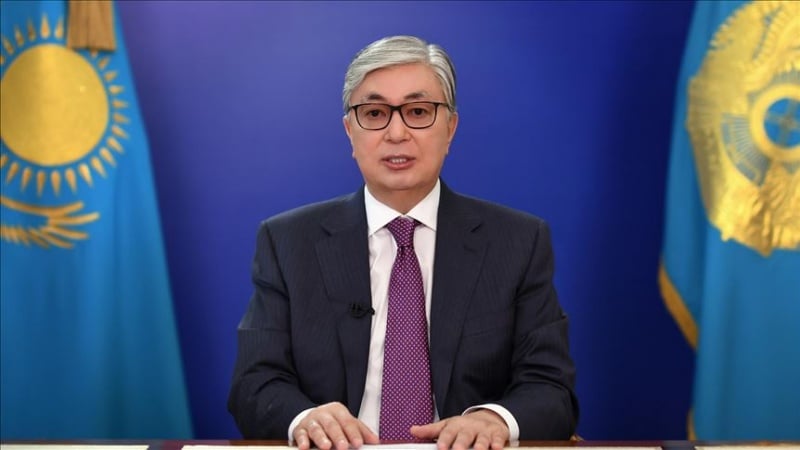
As Central Asian countries seek new and efficient routes for exporting goods and accessing global markets, the Trans-Afghan Corridor has emerged as a strategic and key option.Kassym-Jomart Tokayev, President of Kazakhstan, stressed the need to expand this corridor during the Supreme Eurasian Economic Council meeting held in St.
Kabul 24: Petersburg, Russia. He stated: “Direct access for our countries to the markets of South Asia, the Middle East, and Africa can be ensured through the joint development of the Trans-Afghan Corridor.
To this end, it is necessary to significantly increase the capacity of the railway route connecting Russia, Kazakhstan, Turkmenistan, Afghanistan, and Pakistan.”Tokayev also proposed that the Eurasian Development Bank provide financial support for the project, adding: “Financial backing from this bank could dramatically accelerate the implementation process.”Tokayev’s emphasis comes at a time when member states of the Eurasian Economic Union (Russia, Kazakhstan, Belarus, Kyrgyzstan, and Armenia) are looking to reduce reliance on traditional transit routes and bypass Western sanctions.
The Trans-Afghan Corridor not only offers the shortest connection from Central Asia to Pakistani ports (Karachi and Gwadar) but could also substantially boost regional trade volumes.
Economic experts believe that the full operationalization of this project would transform Afghanistan into a regional transit hub. Key benefits for Afghanistan include a significant increase in transit revenues (potentially hundreds of millions of dollars annually), the creation of thousands of direct and indirect jobs, attraction of foreign investment in infrastructure, and strengthening of the country’s geopolitical and economic position.
Furthermore, the Trans-Afghan Corridor could contribute to economic development in Afghanistan’s northern and central provinces and integrate into larger corridors such as the “China-Kyrgyzstan-Uzbekistan-Afghanistan-Pakistan” route.Progress has already been made: technical negotiations among stakeholders continue, feasibility studies have been conducted, and construction of certain railway sections within Afghanistan has begun.
With financial and political support from Eurasian member states, the project’s pace is expected to accelerate.
Tokayev’s remarks signal strong determination in Central Asia to position Afghanistan as a key partner in regional transit networks, potentially opening a new chapter in post-political change economic cooperation.