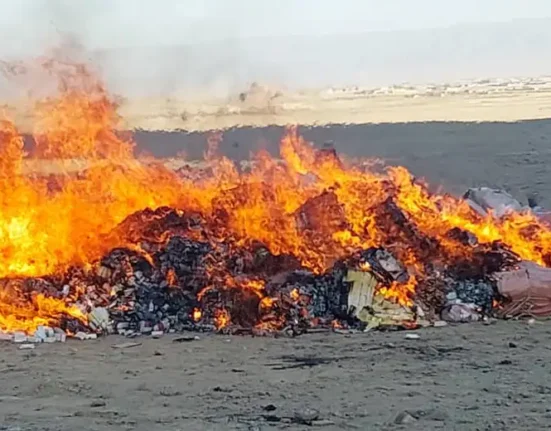


The Saudi Ministry of Energy announced the preemptive closure of its strategic East-West pipeline following a drone attack that struck key pumping stations along the route. Capable of transporting up to seven million barrels of crude oil per day from the Persian Gulf coast to the Red Sea port of Yanbu, the pipeline had served as Riyadh’s primary export lifeline after the closure of the Strait of Hormuz amid the US-Iran conflict.
Kabul 24: Satellite imagery and news reports confirm extensive damage and severe fires at multiple pumping facilities. Senior Saudi officials and a statement from the Foreign Ministry indicated that the drones were launched from Iraqi territory, with early reports confirming several injuries resulting from the strikes.
The Saudi Foreign Ministry stated that while it is temporarily withholding retaliatory action at the request of the Iraqi Prime Minister, Riyadh reserves the full right to take all necessary measures to protect its sovereignty and critical infrastructure.
In response, the Iraqi government and military condemned the attack, welcomed Saudi restraint, and announced an immediate investigation to identify and prosecute those responsible. Meanwhile, the Secretary-General of the Gulf Cooperation Council urged Baghdad to take decisive action to prevent future attacks.
The crisis in global energy markets deepened simultaneously as Houthi forces solidified control over the strategic Bab el-Mandeb Strait. Saudi and Yemeni authorities reported that the Houthis seized Perim Island and reached the coastal city of Dhubab, giving them control over another key maritime passage connecting the Red Sea to Asian trade routes.
The simultaneous disruption of Saudi Arabia’s primary alternative overland pipeline and the tightening bottleneck at key maritime checkpoints triggered immediate shockwaves across global energy markets, driving Brent crude prices past $104 per barrel on Friday amid escalating supply concerns.