

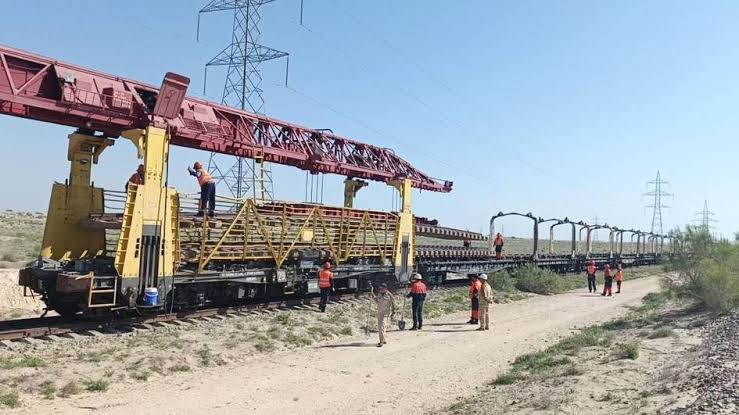
Uzbek Railways has announced the completion of a new 1,000-meter railway siding at Naibabad station along the Hairatan–Mazar-i-Sharif railway line in Afghanistan.
Kabul 24: The project aims to speed up cargo handling, reduce congestion at the station, and improve the overall efficiency of freight operations between the two countries.
Uzbek Railways officials stated that trade volume between Afghanistan and Uzbekistan has been steadily increasing, turning the Hairatan–Naibabad–Mazar-i-Sharif route into one of the most important regional trade corridors.
The new siding will allow for simultaneous processing of more wagons, minimize delays, and increase the station’s capacity for loading and unloading operations. The work was carried out by Uzbek Railways in cooperation with Sogdiana Trans.
Meanwhile, Afghanistan’s Ministry of Public Works has welcomed the development, describing it as part of joint efforts to expand the country’s railway network.
Mohammad Ashraf Haqshenas, spokesperson for the ministry, said: “The Islamic Emirate of Afghanistan is working to provide more facilities for national traders on one hand, and to increase cargo volumes through various routes on the other.”He added that the Hairatan–Mazar-i-Sharif railway line serves as a key rail corridor linking Kabul and Tashkent, and the Naibabad project represents an important step in strengthening this corridor.Afghanistan and Uzbekistan maintain close cooperation in several railway sectors.
These include the rehabilitation and maintenance of the Hairatan–Mazar-i-Sharif line, the Afghan-Turan project (currently in the feasibility study phase), and the Herat–Mazar-i-Sharif railway project, for which technical work is being carried out by the Uzbek side.
The construction of the 1,000-meter siding at Naibabad significantly boosts the station’s capacity, especially for handling bulk and non-oil cargo.
This development comes as bilateral trade between the two countries continues to grow, with both sides emphasizing the expansion of border and transit infrastructure.
Experts believe such projects not only facilitate bilateral trade but also help strengthen Afghanistan’s position as a vital bridge connecting Central Asia and South Asia.Officials from both countries have expressed hope that continued cooperation of this kind will lead to a significant increase in rail freight volumes and reduce transportation costs for traders.
The new project reflects the shared commitment of Afghanistan and Uzbekistan to develop regional railway corridors and make maximum use of existing infrastructure potential.