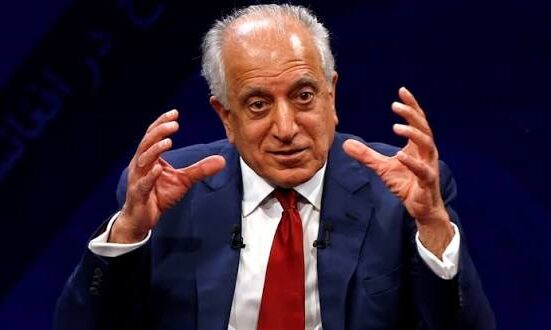

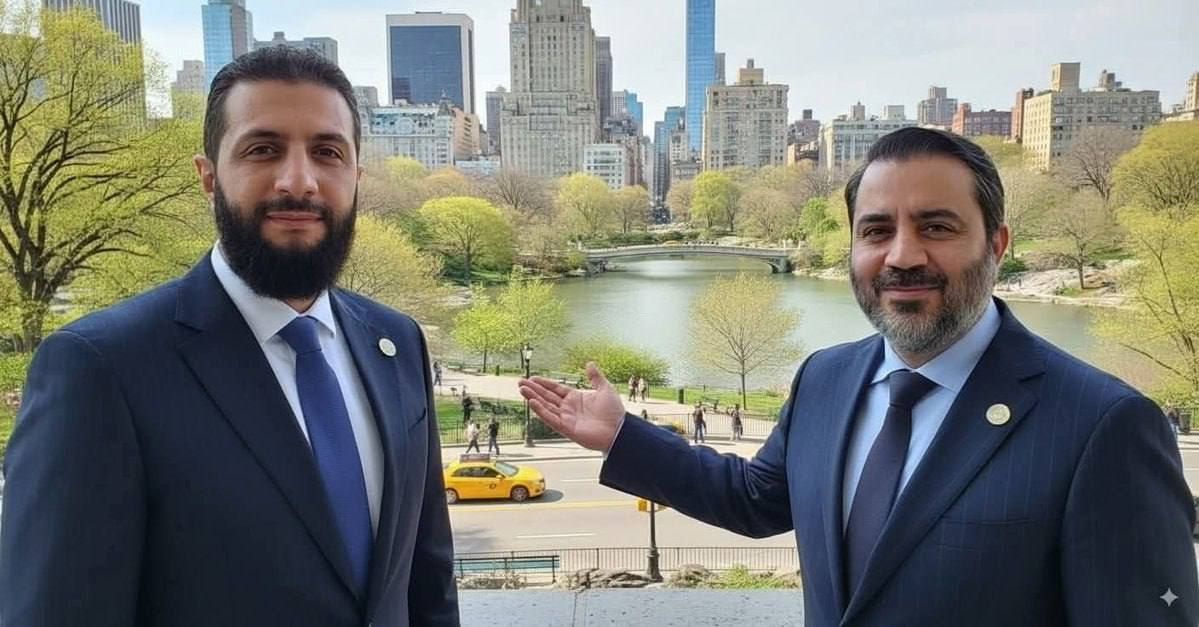
The red carpet rolled out in New York for Ahmad al-Sharaa, the interim president of Syria, is one of the most astonishing events of recent years.
Kabul 24: A former member of ISIS, a commander of al-Qaeda, and someone who fought against Americans for years and was their prisoner for just as long, is now their esteemed guest! Truly, who has changed? America? Ahmad al-Sharaa?
Or the context and times of both?The photo of Mr. al-Sharaa and his foreign minister, Asaad al-Shaibani, with Manhattan’s skyline in the background, has all the characteristics of a surreal image.
Shaibani, cheerful and smiling, is pointing to what? Perhaps he wants to say, “This is the America I see!” The America I Saw is a book written exactly 75 years ago by Sayyid Qutb, the Muslim thinker and theorist of jihad.
Qutb, considered the ideological mentor and political guide of al-Sharaa and his peers, devoted this book entirely to rejecting and condemning modern civilization, with America—the pinnacle of wealth and prosperity—as its crown jewel.
This extreme indictment, which went so far as to label Western modernity as “new ignorance,” was part of Qutb’s effort to transform Islam into a revolutionary ideology and present it as an alternative to the status quo. Mr. al-Sharaa and his predecessors spent decades confronting Western targets and their allied regimes in the Middle East based on Qutb’s approach and the subsequent reinterpretations by his disciples.
But what has happened now that merely obtaining a U.S. visa and meeting its diplomats is not only an achievement but also considered a political virtue?
America remains as it was. With its unconditional support for Israel, standing against the entire world for Israel’s sake, and having a president like Trump, its prestige and soft power have been severely damaged.
But Mr. al-Sharaa, out of expediency and circumstance, has changed significantly.
This transformation is the fate of all revolutionaries who come with the ambition to fundamentally change the global order but end up settling for a small or large share, resting their heads on the pillow of conservatism, and occasionally offering salutations to the global hegemon.
From China and the Soviet Union to Vietnam, Cuba, and even Taliban-ruled Afghanistan, they eventually realize that challenging the global system is futile, and integrating into it is more beneficial and cost-effective.
The honor of discovering and condemning America through personal observation and defense belongs not to Sayyid Qutb but to a revolutionary communist poet.
Vladimir Mayakovsky, the Russian futurist writer, traveled to America exactly a century ago, a quarter-century before Qutb, and later wrote The America I Discovered.
A book filled with criticism, rejection, and mockery of America from someone who came from “Lenin’s Moscow.” Mayakovsky ended his life in his homeland, Russia, just five years after this trip, reportedly due to disillusionment with the failures and contradictions of the Russian revolutionary government and its indescribable violence against nearly all social classes and groups.
Astonishingly, Sayyid Qutb, too, was executed by Nasser’s anti-American regime fifteen years after returning from his trip to America.
His brother and intellectual heir, Muhammad Qutb, fled to Saudi Arabia and sought to blend his brother’s ideas with Wahhabi Islam, creating a synthesis aligned with the religious approach dominant in America’s closest Muslim ally.
Salahuddin Khadiw