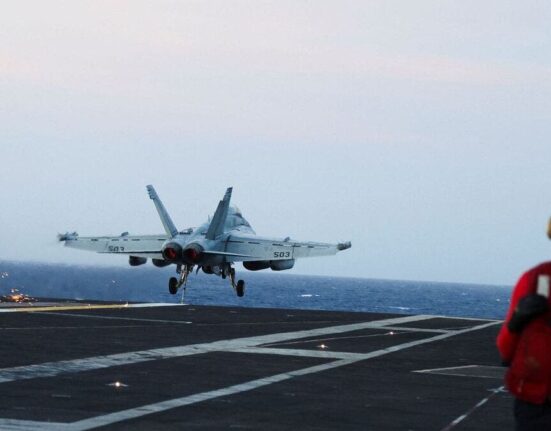

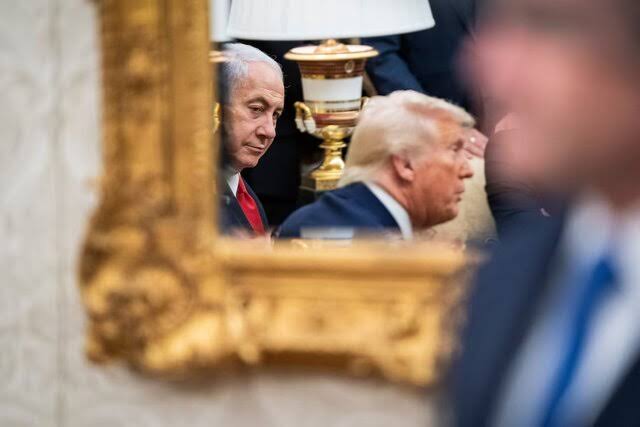
Israel’s Channel 12 reports that Israel conducted a military operation in Qatar with the U.S.’s tacit approval.
Former President Trump commented after Qatar’s Prime Minister revealed that the U.S. informed Qatari authorities of the attack ten minutes after it occurred, stating, “Witkov informed the Qataris, but the deed was already done!”
Kabul 24: When, in the midst of sensitive negotiations held with U.S. knowledge and on the soil of its ally, the U.S. allows Israel to attack the host or dialogue partner, this is no trivial matter. This move undermines the very foundation of diplomatic architecture and reinforces an unconventional pattern: “prior notification” by a great power instead of “formal permission,” yet in practice, it carries the same weight as a green light.
This phenomenon is not without precedent. In 1981, Israel bombed Iraq’s Osirak nuclear facility. The U.S. did not formally approve, but Washington’s silence was widely seen as implicit consent.
Days before Saddam Hussein’s invasion of Kuwait, he met with April Glaspie, the U.S. Ambassador to Iraq, in Baghdad. Saddam expressed frustration over Kuwait’s OPEC policies and border disputes, making veiled threats.
According to the leaked transcript, Glaspie responded, “The United States takes no position on Arab-Arab conflicts and does not interfere in your border disputes.” Saddam interpreted this as a green light.In 2007, Israel’s attack on Syria’s nuclear site involved some level of U.S. intelligence coordination.
Over the past decade, Israel’s numerous operations in Syria have often been accompanied by “deconfliction” mechanisms between Moscow and Washington.The pattern is consistent: unilateral attacks, prior notification to great powers to avoid unintended clashes, and the host or third party bearing the cost.The logic is clear.
For Israel, these actions signal to regional rivals that its security red lines are non-negotiable. For the U.S., prior notification mitigates risks and manages fallout without assuming direct responsibility.
For the mediator or host, the outcome is often the same: eroded trust in their neutrality and the security of negotiations.
The consequences extend beyond a limited military strike. First, mediation capacity is weakened.
When Qatar, a key mediator in Afghanistan, Yemen, and Palestine, is attacked, it signals to other nations that hosting talks comes with risks. Second, opponents of diplomacy are emboldened, as those skeptical of negotiations now have fresh evidence of violated sovereignty.
Third, international law is further undermined. Attacking a third country’s soil without consent is a clear breach of sovereignty, yet with a great power’s tacit approval, it becomes an “imposed reality.”From an international relations perspective, this creates a profound contradiction.
Great powers claim diplomacy is the only sustainable solution, yet their silence or covert support renders the negotiation table unsafe.
This erodes trust in mediators, makes dialogue harder to sustain, and increases the likelihood of coalitions forming against such practices.There is no simple fix, and this appears to have become a U.S. norm.
Still, some points are clear. First, mediators must predefine their security red lines: multilateral guarantees, rapid response mechanisms, and transparency in notifications.
Second, great powers must clearly distinguish between “notification to avoid escalation” and “political green lights,” or risk damaging their global mediation credibility.
Finally, future hosts of negotiations must recognize that without collective protective mechanisms, their security will be sacrificed to geopolitical games.Ultimately, hidden green lights may manage a crisis in the moment, but their long-term cost is far greater: eroded trust in diplomacy, normalized violations of sovereignty, and the triumph of force over dialogue. This is where international relations slides from reconstruction toward recurring crises.