
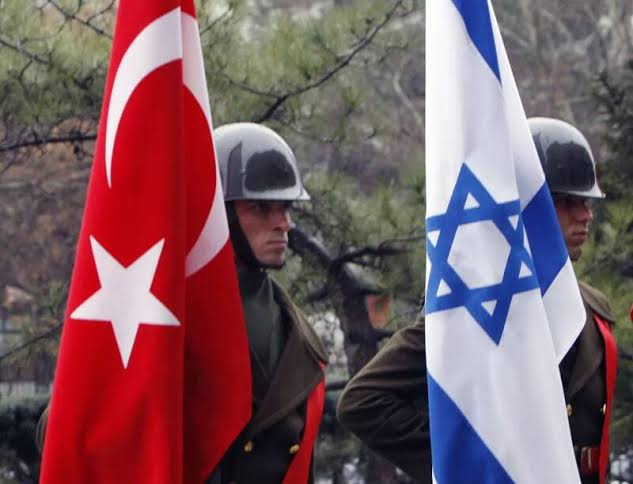
As Israel pursues its aggressive and ideologically driven policies, adopting a reckless and irrational approach in the region, it has successfully pressured the United States into attacking Iran. Many regional countries still fail to grasp that no alliance or friendship can shield them from this threat. Following Israel’s assault on Iran, Turkey has explicitly redefined its defense doctrine and raised its alert level. A staggering 96% of Turks view Israel as an enemy, signaling that the region is bracing for new crises.
According to Kabul 24, citing Al Jazeera, U.S. President Donald Trump announced a ceasefire agreement between Israel and Iran early this morning. The deal, set to formally end the “12-day war” 24 hours after its implementation, raises a critical question: Could a similar scenario unfold between Turkey and Israel? To be blunt, as long as decision-makers in Washington and Tel Aviv are guided by theological and irrational beliefs, no country is safe from the flames of such conflicts.
A New World Order: From the Promised Land to Illusions of Rationality in the White House
Countries that believe their good relations with Trump or lack of direct conflict with Israel offer protection are gravely mistaken. Those driven by theological and irrational worldviews render any nation vulnerable. This is the same crisis now gripping Europe, where actors prioritizing ideological fantasies over geopolitical realities expose themselves to reckless actions.
Israel’s behavior is predictable because it no longer conceals its “Promised Land” ambition, openly turning it into a political agenda. Any regional state under the illusion that its ties with the U.S. ensure safety, yet shares borders with territories Israel claims as its “Promised Land,” should expect a strike—directly or indirectly—via U.S. influence.
In the U.S., a parallel ideological current mirrors Israel’s irrational approach, sidelining logic and geopolitical realities in foreign policy. The core issue for regional states is their failure to recognize that global decisions are increasingly detached from reason or strategic interests.
Erdoğan and New Red Lines: An End to Israel’s Unrestrained Actions?
Turkey-Israel relations have seen two distinct phases. Initially, Turkish governments with close ties to Israel shifted focus toward Europe, which never fully accepted Turkey but kept it on the cusp of membership. During this period, Israel operated with unchecked freedom in the region. Any Turkish objection faced U.S. pressure and internal unrest.
The turning point came with Recep Tayyip Erdoğan’s rise to power. For the first time, Turkey firmly signaled to Israel that its unchecked regional dominance was over. This shift was crystallized at the 2009 Davos Forum, where Erdoğan’s iconic “One Minute” outburst publicly challenged Israel’s leadership.
As Erdoğan’s media advisor at the time, I accompanied him to Davos. On the return flight, during a meeting with his advisory team, Erdoğan declared unwaveringly, “No matter what happens, we will not back down.” This marked the start of a historic shift for Turkey.
In response, Israel began efforts to destabilize Turkey internally, eventually supporting the Gülenist network—led by Fethullah Gülen, then residing in the U.S.—in a failed military coup on July 15, 2016. The coup claimed 251 lives and injured over 2,000, but Turkey emerged stronger, despite covert U.S. and Israeli backing of the plot.
Extremist Currents in Tel Aviv and Washington: Defying Geopolitical Rationality
Many regional states fail to recognize that Israel, unbound by political rationality or geopolitical realities, alongside a similar U.S. faction, is capable of extreme and irrational actions. These forces are not only harsh toward Muslim nations but also toward their closest European allies.
As long as decisions are driven by theological fervor rather than rational interests, the region and the world face grave risks. The U.S.’s rhetoric toward its traditional European allies hints at how it might treat Muslim nations. Until recently, Iran was Washington’s “red line,” yet Israel easily crossed it. Now, Israeli media openly label Turkey as the next adversary. This is unsurprising, given Israel’s ideological fixation on the “Promised Land,” which fuels such dangerous adventurism.
96% of Turks View Israel as an Enemy
Attacking Iran was a long-standing Israeli ambition, but Tel Aviv struggled to convince Washington for years. Ultimately, Israel succeeded in pushing the U.S. to bomb Iran’s nuclear facilities. Anyone assuming Israel will stop here is mistaken. Turkey views Israel’s aggressive and expansionist policies as a direct threat to its national security, prompting a comprehensive overhaul of its defense and security doctrines. Post-Iran attack, Erdoğan announced that Turkey would redesign its strategic frameworks.
With Israel’s aggressive policies now manifesting as military actions, no country can consider itself safe, especially as the “Promised Land” vision has become an operational policy. Turkey, boasting one of the world’s largest armies and defense industries, is actively reassessing its security strategies to counter Israel’s expansionist threats.
Significantly, 96% of Turks see Israel as a serious threat and are outraged by its policies. As long as Israel clings to its “Promised Land” dream, no Middle Eastern nation—government or people—will be safe. Why many deny this reality remains a mystery.