
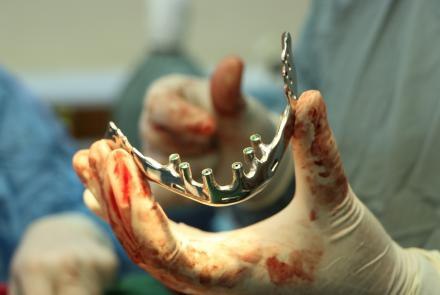
The 400-bed Specialized Hospital of Martyr Sardar Mohammad Dawood Khan in Kabul has successfully performed Afghanistan’s first lower jaw (mandible) reconstruction surgery using a custom implant.
kabul 24: The patient, Abdul Salam from Helmand province, suffered a complete bone defect in the right side of his lower jaw seven years ago after being hit by a bullet.
The injury severely impaired his ability to chew and speak. He had previously undergone multiple unsuccessful surgeries abroad, leaving him with persistent difficulties.
Following the recent procedure at the Dawood Khan Hospital, Abdul Salam reports significant improvement and relief from his longstanding problems.Speaking to TOLOnews, Abdul Salam said: “I had several operations in foreign countries, but they didn’t yield good results.
Now that we had the surgery here at Dawood Khan Hospital, my condition is much better.”Hospital officials confirmed that the complex operation was carried out by Afghan specialists from the maxillofacial and jaw surgery department, with technical collaboration from an Indian expert (referred to as Dr. Kumar in some accounts).
Dr. Farid Ahmad Khaldi, the lead surgeon, explained: “With the cooperation of Dr. Kumar, who assisted in this operation, the custom device was brought in. Afterward, our specialist team implanted the artificial lower jaw.
The surgery was successful.”The custom mandibular implant was tailored specifically for the patient, marking a milestone in advanced reconstructive surgery within Afghanistan.
This achievement highlights growing capabilities in the country’s medical sector, particularly at the military-affiliated Dawood Khan Hospital, which has been expanding specialized services.
Other patients facing similar mandibular defects have appealed to the Ministry of Defense leadership to facilitate treatment for them as well, underscoring the demand for such advanced interventions amid ongoing challenges from conflict-related injuries.
The procedure represents a step forward in local medical expertise, reducing reliance on overseas treatment for complex cases. Officials hope it paves the way for more such operations, benefiting war-wounded individuals and others with severe facial trauma.
The success demonstrates effective international technical partnerships and the hospital’s commitment to improving reconstructive care in resource-constrained settings.