
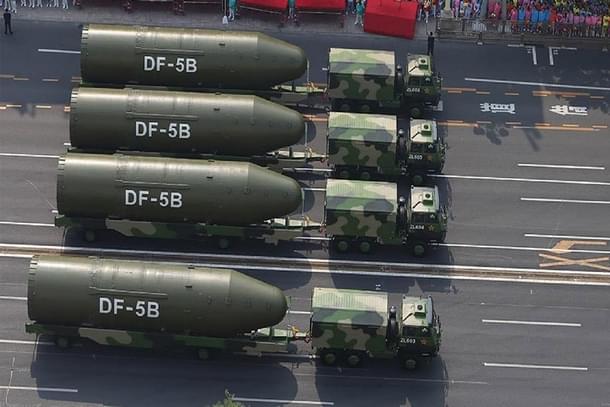
According to a draft Pentagon report accessed by Reuters on December 22, 2025, China has likely deployed more than 100 solid-fueled DF-31 intercontinental ballistic missiles (ICBMs) across three new silo fields near its border with Mongolia.
Kabul 24: This marks a significant acceleration in Beijing’s nuclear modernization efforts, as previous assessments had identified the silos but not confirmed the loading of missiles.
The report highlights that China’s nuclear warhead stockpile remains in the low 600s as of 2024, reflecting a slightly slower production rate compared to prior years.
However, the expansion continues unabated, with projections indicating China is on track to possess over 1,000 operational nuclear warheads by 2030—faster than any other nuclear power.A key concern in the draft is China’s military posture toward Taiwan.
The Pentagon assesses that Beijing expects to be capable of fighting and winning a war over the island by the end of 2027. This timeline aligns with directives from Chinese leader Xi Jinping for the People’s Liberation Army to achieve specific modernization milestones.
The report notes China is refining options for “brute force” operations, including long-range strikes up to 1,500–2,000 nautical miles, which could disrupt U.S. military presence in the Asia-Pacific region.Despite U.S. interest in arms control—recently echoed by President Donald Trump, who has discussed potential denuclearization talks involving China and Russia—the draft states Beijing shows “no appetite” for such discussions or broader arms control measures.
The document also addresses internal challenges in China’s defense sector, including an ongoing anti-corruption campaign that has targeted at least 26 senior managers in state-owned arms companies over the past 18 months.
These purges, expanding into nuclear and shipbuilding industries, may impact short-term readiness but could improve long-term efficiency.
This draft report, which may undergo changes before official release to Congress, underscores escalating strategic competition between the U.S. and China.
While China maintains a defensive nuclear strategy and minimum deterrence posture, the rapid buildup raises global concerns about stability, especially amid tensions over Taiwan—a democratically governed island Beijing claims as its territory.
Experts note that capability does not equate to intent, and conflict remains neither imminent nor inevitable. Nonetheless, the findings highlight the need for enhanced deterrence and diplomacy to manage risks in the Indo-Pacific.