
According to Axios, the draft agreement between Iran and the United States is ready for signature, but Trump has requested a few days to give final approval.
Kabul 24: Trump’s hesitation reflects the difficult position he finds himself in. The U.S. president has very limited room to maneuver between two fundamentally contradictory choices: lowering gasoline prices in America and preparing for the midterm congressional elections in November, on one hand, and restricting Iran’s nuclear program, on the other.
The negotiated draft focuses primarily on reopening the Strait of Hormuz and postpones negotiations on the nuclear program to a second phase.
Under the agreement, Iran would reopen the strait within one month, in exchange for some sanctions relief and the lifting of the blockade on its ports.This deal would act as a painkiller for the globally pressured economy and Iran’s crisis-hit economy.
However, it leaves the main issues unresolved — like the fate of the enriched uranium stockpiles — and essentially leaves the bone in the wound.In reality, its primary function is to restore the situation to the pre-March 9 (before the war began) equation, implicitly acknowledging Iran’s geopolitical advantage in controlling the Strait of Hormuz.
Naturally, this is not something the hawks in the Republican Party, Israel’s right-wing government, or even some Arab U.S. allies would welcome.
More importantly, it undermines Trump’s propaganda about achieving an agreement better than the JCPOA and superior to Obama’s record.Trump probably needs these two or three days to think through these challenges.
His next option is returning to war, which also comes with its own limitations. Using ground forces and territorial occupation on the Iraq or Afghanistan model is a red line for Trump.
Moreover, Iran’s geography and multiple geopolitical advantages reduce its appeal for any occupying force.It could even be said that Trump, to escape this impasse, is considering a comprehensive peace with Iran by turning it into what is termed a “normal actor.” His recent remarks about the need for Turkey, Saudi Arabia, Pakistan, and Iran to join the Abraham Accords reflect high-level wishful thinking.Iran, understanding the aforementioned limitations, views continued resilience and steadfastness — despite the heavy blows received during the war — as a contest of wills.
In this battle, it sees itself in a stronger position due to its higher pain tolerance threshold compared to its rival.As mentioned, Trump’s margin for maneuver is narrow.
A third path he is probably considering — and one also favored by the Israeli side — is accepting a limited deal for the partial reopening of the Strait of Hormuz to reduce energy prices.
Control of the strait is the lever that has saved Iran from the fate of Iraq in the 1990s and from becoming a fragile state. Strategic logic dictates that it should not easily give up this important card.
With this in mind, it can be said that what will be achieved at this stage is a partial reopening of the strait. What remains, however, is the determination of the U.S. and Israel to turn Iran into a weakened state through military, economic, and security pressures, alongside Tehran’s decision to increase its deterrent levers, including its nuclear program.
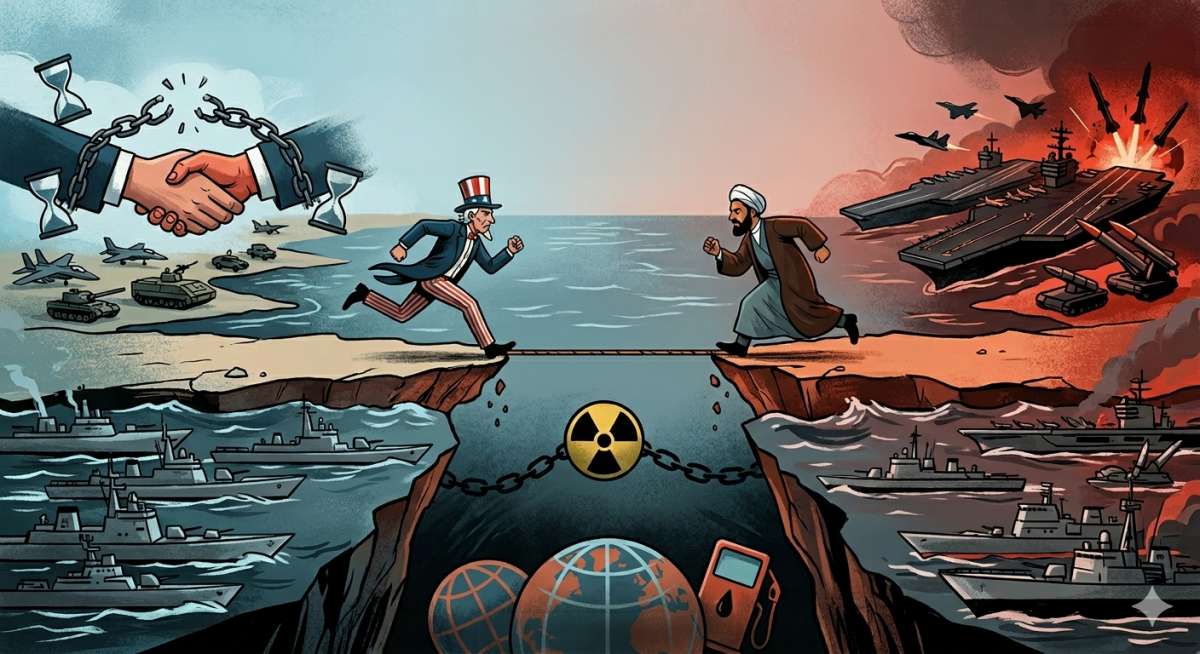
Based on this, it can be predicted that in the short term, the current neither-war-nor-peace situation will continue in a precarious, unstable manner, and both sides will enter the second round of the Chicken Game* — which, unlike the previous round, will be more based on endurance and greater pain tolerance.
In this phase, economic resilience will determine the final outcome.*Two drivers head toward each other at high speed on the same path. One must swerve off the road, otherwise both will collide and die.
If one driver swerves, that driver loses and is called a “chicken” for being cowardly; the driver who stayed on course is declared the winner.
Salahuddin Khadiv