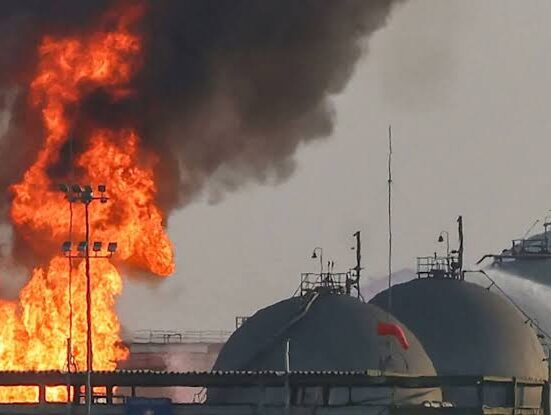


Today’s U.S. attacks on three Iranian tankers indicate that Washington is seeking to create a new equation in its confrontation with Iran—one that can be summarized as: a ship for a ship.
Kabul 24: Under this logic, if Iran attacks a ship or vessel, even if the attack is unsuccessful, the U.S. can target an Iranian tanker in retaliation. The Americans have openly stated that the goal of these actions is to pressure Iranian oil exports, disrupt the oil transport chain, and intensify what they call “economic rage” against Tehran.
Washington’s strategic objective is clear: to deprive Iran of its most important source of revenue without directly striking oil facilities, which would trigger an uncontrollable spike in global oil prices. In other words, Washington is attempting to target Iran’s export lifeline rather than destroying its oil industry.
However, the more critical question is Iran’s response.
If the U.S. can target Iranian tankers without paying a heavy price, this equation will gradually settle in Washington’s favor. Therefore, to alter the rules of the game and draw new red lines, Iran will be forced to impose a reciprocal cost. One of the most likely avenues is targeting tankers or commercial vessels belonging to U.S. allies in the region. The Islamic Revolutionary Guard Corps (IRGC) announced tonight that it targeted three tankers in retaliation for Washington’s aggression.
Forty years ago, the Persian Gulf witnessed a large-scale military confrontation known as the Tanker War.
That war began with Iraq taking the initiative, launching repeated and heavy strikes on Kharg Island and Iranian tankers to sever Iran’s oil exports.
Iran retaliated with counterattacks on ships and tankers belonging to countries supporting Baghdad, including Kuwait and Saudi Arabia. This paved the way for the deployment and intervention of the U.S. Navy under the pretext of protecting freedom of navigation.
Despite attacks on hundreds of ships and the deaths and injuries of hundreds of mariners, oil exports from the Persian Gulf were never fully halted.
Yet, today’s situation differs significantly from that era. The global economy is far more sensitive to energy markets and maritime security, meaning any expansion of a tanker war could yield much broader consequences.
By expanding maritime attacks, Iran could pursue two goals: first, forcing the U.S. to retreat from strikes on Iranian tankers; and second, driving up oil prices to raise the economic cost of the conflict for the U.S. and its allies.
Ultimately, everything depends on the success or failure of the U.S. in maintaining the secure maritime corridor it reportedly established near the coast of Oman. If this corridor continues operating without major disruptions, the strategy of pressuring Iranian exports will retain a crucial leverage point. However, if Iran manages to effectively challenge maritime security in the region, the U.S. will face costs that may alter its initial calculations.
In truth, the theater of conflict resembles an hourglass more than ever: both sides are striving to force the other to back down before they themselves run out of time.
Salahaddin Khadiv