
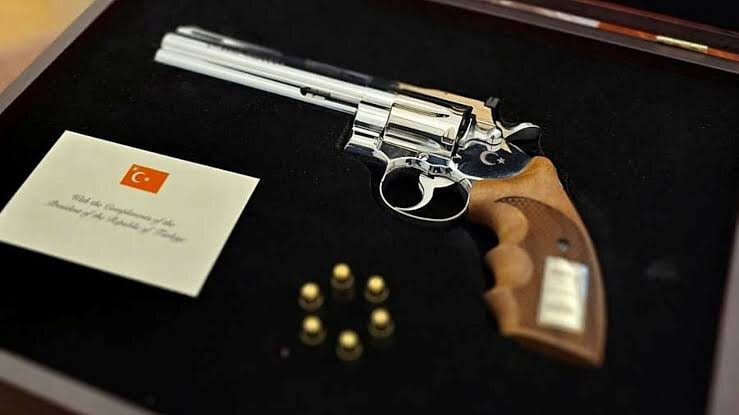
At the sidelines of the recent NATO summit, Recep Tayyip Erdoğan surprised his Western counterparts with an unusual gift. He presented each participating leader with a Gümüşhane pistol manufactured by the Turkish defense company MKE, along with six live rounds — a gesture rarely seen in diplomatic protocol between heads of state.
Kabul 24: Far from evoking political ceremony, it strongly recalled the atmosphere of Western films.From that moment, the question arose: Why did a president who aspires to play a global role choose the language of weapons and the behavior of guerrilla leaders to convey his message?
The answer may lie in the official narrative of MKE. Although the company in its current form was established in 1950, it traces its lineage back to the cannon foundries of the era of Sultan Mehmed the Conqueror.
Regardless of the historical accuracy of this claim, its political function is what matters: linking today’s Turkish defense industry to the glory of the Ottoman Empire.
This is precisely the pattern Erdoğan’s government has pursued over the past two decades — a blend of nationalism, technology, and history. In this narrative, the Bayraktar drone is not merely a military product but a symbol of revived national pride; a pride meant to instill in Turkish citizens — and the world — that Turkey has transformed from a consumer of security into a producer of power.
On the other hand, Erdoğan’s unexpected action recalls the political norms of revolutionary movements and guerrilla leaders — partisans who challenge the rule-based political order of states and the international system.
In this sense, Erdoğan’s display is a moderated, reformist version of the revisionist idea pursued by countries like Iran, Russia, and China, which seek to move beyond the current Western-centered order.
It is not unlikely that the most important audience for this spectacle was Donald Trump — the president who, throughout the summit, praised Erdoğan more than any other leader.The reason for this admiration is not particularly complicated.
For years, Trump has delivered a consistent message to Europe: pay for your own security. In his view, a continent facing slow economic growth, a demographic crisis, and limited defense budgets cannot rely forever on the American security umbrella.
In this picture, Turkey is an exception — a country with a large army, a growing defense industry, and a geopolitical position stretching from the Black Sea to the Middle East and the Mediterranean.
If Washington’s strategic priority gradually shifts from Eastern Europe to East Asia, the importance of the country controlling NATO’s southern flank will increase significantly.Of course, this is not the first time America has questioned the costs of defending Europe.
Even at the beginning of the Cold War, Washington accepted the burden of European security reluctantly, not enthusiastically. But in those days, the Soviet threat was so great that there was no other choice.
Today, too, Trump — with his transactional logic — is repeating the same old question in different language: Why should America pay for the security of others?In this equation, Erdoğan knows well what his trump card is.
He is no longer merely the leader of a country on the margins of Europe; he wants to present himself as one of NATO’s main pillars. Perhaps that is why, instead of a commemorative pen or watch, he gifts a revolver.
The biggest challenge to this warm partnership is Israel, with which Turkey is engaged in a major geopolitical rivalry — while Washington remains an ally of both. Managing this conflict of interests is not easy for the White House.
In some ways, it resembles the strong opposition of France and Germany to the rearmament of Germany after World War II — something that ultimately proved necessary to counter Soviet expansionism.But this story has another side.
The NATO that once presented itself as the standard-bearer of democracy and the rule of law now sees two of its most influential members — the United States and Turkey — as countries where one is often described in international indices as a “flawed democracy” and the other as an example of “electoral authoritarianism.” This aspect may not be entirely unpleasant from Trump’s perspective either.
The irony of the situation became clear when many European leaders were unable to take Erdoğan’s gift back to their countries. Strict laws on carrying and possessing weapons, customs formalities, and flight restrictions left the Ottoman pistol stranded behind Europe’s borders.
Turkey, with the language of power and flexibility, seeks to project self-confidence, while Europe continues to operate within the framework of rules and law — the very club that Ankara has aspired to join for decades but still remains outside its doors.
Salahuddin Khadiv