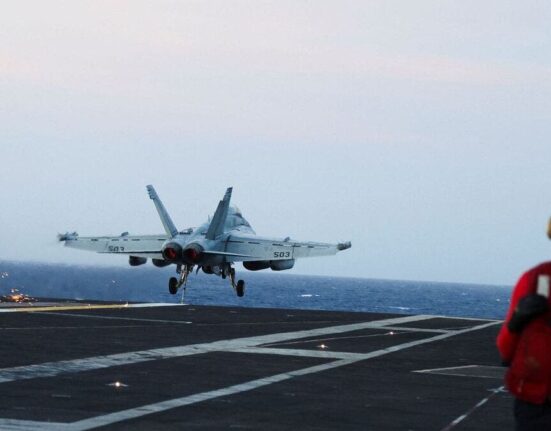

Few operations, except perhaps a potential Chinese invasion of Taiwan, have been as thoroughly examined, practiced, and debated (a potential U.S. strike on Iran) as this one. Technically, military and geological experts say this operation should be feasible.
Analysis by David Sanger, reporter for The New York Times:
However, this operation is fraught with risks—known and unknown dangers, as former Defense Secretary Donald Rumsfeld once noted regarding the Iraq war, which turned into another endless quagmire for the U.S. military in the Middle East. For this reason, over the past 16 years, all U.S. presidents have hesitated when considering it.
U.S. President Donald Trump emphasized on Wednesday that he has not yet decided to carry out what is privately referred to in some circles as the “big strike.” However, the warlike tone he had the day before was no longer present. Instead, signs of caution were evident. He told reporters on the South Lawn of the White House: “Maybe I’ll do it, maybe I won’t. I mean, nobody knows what I’m going to do.”
Meanwhile, after five days of enduring astonishing losses from Israel, it seems the Iranians are seeking a way out of the crisis. Iran’s leader, Ayatollah Ali Khamenei, gave a defiant response to Trump’s demand for “unconditional surrender,” but Trump said there are signs that the Iranians want to negotiate, and reports emerged of an official Iranian plane landing in Oman—a place where prior talks with Steve Witkoff, the president’s special envoy, had taken place before Israel’s attack.
If Trump is now pausing, it might be because the list of things that could go wrong is long and likely incomplete.
The most obvious risk: there’s a chance one of the B-2 bombers could be shot down, even with Israel’s success in destroying much of Iran’s air defenses. Additionally, miscalculations could occur, and even America’s largest conventional bomb might not penetrate deep enough.
Rafael Grossi, Director General of the International Atomic Energy Agency, said last week at the start of Israel’s operation: “I was there; these facilities are half a mile underground.”
But even if the operation itself succeeds, many experts say the greater dangers lie in its aftermath—much like Afghanistan and Iraq. One of the most critical lessons from that dark period of U.S. foreign policy is that unknown risks are the ones that cause the most harm.
Iran has promised to retaliate if the U.S. attacks—likely targeting U.S. bases across the Middle East and military assets in the Persian Gulf and Mediterranean. All of these are within the range of Iran’s missiles—provided any missiles or launchers remain after Israel’s strikes.
Of course, this could spark a cycle of tension and conflict: if Americans are killed or even injured, Trump will face pressure to retaliate.
Daniel Kurtzer, former U.S. ambassador to Israel, and Steven Simon, a former National Security Council official, wrote in Foreign Affairs on Wednesday: “Handing over the task of dealing with Fordow on Israel’s behalf puts the U.S. directly in Iran’s crosshairs. Iran will almost certainly retaliate by killing American civilians. This, in turn, will force the U.S. to respond.”
They continued: “Soon, the only targets left for Washington will be the leaders of the Iranian regime, and the United States will once again enter the business of regime change—a business that almost no American is interested in anymore.”
Iran’s response could take other forms as well. Iran is skilled in assassination, and in response to a joint U.S.-Israel cyberattack on its nuclear program 15 years ago, it has built a formidable cyber force—not as secretive as China’s or as bold as Russia’s, but capable of causing significant damage. Additionally, Iran still has numerous short-range missiles that could be used to attack oil tankers in the Persian Gulf, making navigation in the region hazardous.
The last thing the White House wants is to publicly acknowledge these risks. Democrats want Congress to have a role, but they lack any legal mechanism to enforce it. Adam Schiff, Democratic Senator from California and a political rival of Trump, said on CNN Wednesday: “Given the potential for escalation, we must be involved in this decision-making. Bombing Fordow is an aggressive act.”
Like many other aggressive actions, there are longer-term risks as well—beyond the cycle of attack and retaliation. The message from the past five days, from the perspective of Iranian leaders or other countries with nuclear capabilities, might be that they should have moved faster and more covertly toward building a bomb. North Korea did just that, and now, with 60 or more nuclear weapons despite years of U.S. diplomacy and sabotage, it has enough deterrence that the U.S. and South Korea will think twice before launching an operation similar to Israel’s attack on Iran.
History shows that nuclear programs can be bombed, but not destroyed.
Gary Samore, coordinator for weapons of mass destruction under the Obama administration, said when the existence of Fordow was revealed: “Force can stop a nuclear weapon—Syria’s program is a good example.” (Fordow’s discovery occurred late in the Bush administration.)
He continued: In Iraq, after Israel bombed the Osirak reactor in 1981 to prevent Saddam Hussein from building a bomb, the Iraqis “built a massive secret program” that wasn’t uncovered until after the 1991 Gulf War. This was so embarrassing for U.S. intelligence that more than a decade later, they overestimated Saddam’s ability to repeat it—leading to a second failure and U.S. entry into the Iraq War.
However, Samore added: “I can’t recall a single instance where air power alone has ended a program.”
This matters to Trump. He must decide within days whether Israel’s attacks on the Natanz enrichment facilities, centrifuge manufacturing workshops, and laboratories likely involved in weapons research have been sufficient to set back Iran’s nuclear program—or not.
In other words, he must decide whether it’s worth the U.S. taking on all the direct risks, with its planes, pilots, and weapons, to destroy the Fordow site—or not.
But he also doesn’t want to be accused of missing an opportunity to set Iran back by several years. Samore, now a professor at Brandeis University, said: “If this war ends and Fordow remains intact, restarting it won’t take long.”
Trump has not raised these questions publicly, and it’s always hard to discern how he weighs the evidence. A few days ago, on Air Force One, when a reporter reminded him that his own Director of National Intelligence, Tulsi Gabbard, had told Congress months ago that Iran had not decided to build a bomb, he reacted sharply.
He insisted that time was running out—though he provided no evidence to contradict his intelligence chief’s statement.
He said on Wednesday in the Oval Office: “Don’t forget, we haven’t gone to war yet. We always add a certain amount of genius to everything, but we haven’t entered a conflict yet. Israel did a very good job today.”
And then, repeating a phrase that has become his mantra, he added: “But we’ll see what happens.”