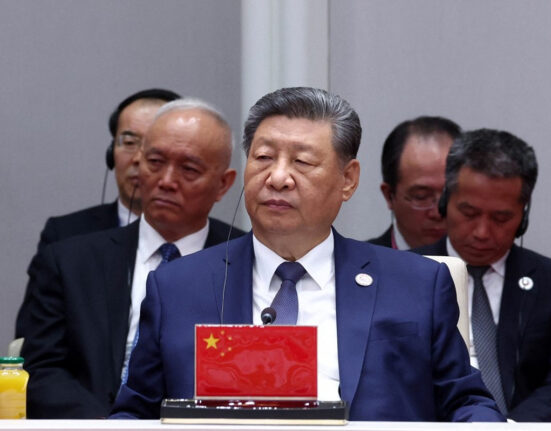

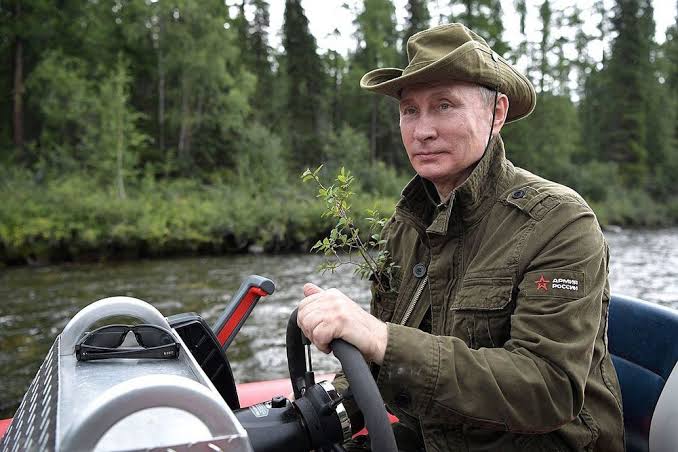
Vladimir Putin, in response to the announcement of the Nobel Peace Prize winner, stated that “the Nobel Committee lost its credibility by not awarding the prize to Trump.” He then praised Trump’s efforts for peace, prompting Trump to express gratitude on his social media platform.
Kabul 24: In the realm of global politics, few contemporary leaders possess Vladimir Putin’s precise understanding of the psychology of power and the symbolic functions of political language.
Putin has repeatedly demonstrated his grasp of “discourse as a tool of power,” showing no hesitation in using exaggerated praise for world leaders when it serves his purpose.
His statement about Trump’s “deserving” the Nobel Peace Prize is a quintessential example of this multilayered game—a seemingly laudatory remark that, in reality, is a strategic maneuver to manage hostility and reduce the cost of confrontation within a pragmatic framework.
In foreign policy, a leader’s “perception of the rival” is as critical as the threat itself. Putin manipulates this perception to shape political reality in Russia’s favor, managing the rival’s narcissism through the language of affirmation.
By symbolically praising Trump, Putin engages in a war of perception, targeting the subconscious of an individual who sees himself as the center of history.
Putin accurately recognizes that Trump, with his cult of personality and excessive need for public validation, is particularly vulnerable to flattery.
This is where political psychology becomes a tool for diplomatic realism, deftly drawing a line between “expediency” and “political morality.”Putin’s approach is rooted in Russian tradition—a tradition that, from Peter the Great to Stalin and now Putin, harbors an internal inclination toward authoritarianism while remaining pragmatic externally.
Peter the Great, despite his interest in Western technology and order, believed Russia had a distinct historical and spiritual mission. He adopted Europe’s technical and scientific models but preserved the Russian ethos rooted in faith, iconography, authority, and collectivism.Stalin allied with the West against the Nazis but never abandoned his ideology.
Similarly, Putin distinguishes between “strategic enmity” and “tactical engagement.” While his expansionist strategy in Ukraine persists, his language, attuned to the rival leader’s personality weaknesses, maintains tactical engagement.
He understands that, despite the inherent conflict of interests between Russia and the United States, every word from Trump can influence the scope of pressures, sanctions, and even Russia’s media image.
Thus, Putin adopts a pragmatic rhetoric, viewing it not as weakness but as a continuation of Russia’s tradition of defensive realism.From this perspective, Putin is a statesman who simultaneously leverages structural theories of power and the psychology of individual leaders.
He harbors neither an inherent hatred for the West nor an infatuation with it; he is simply a player who understands the rules of both worlds and uses them to enhance his strategic maneuvering capacity.
This is what Machiavelli called the “art of managing the enemy”—a form of political efficiency where heavy costs are offset with simple words.