
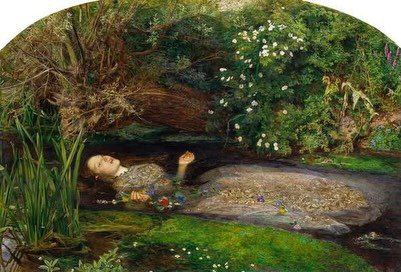
Shakespeare grants Hamlet a love only to destroy it through madness—whether feigned or genuine. Millais, however, paints not the tumultuous scene of words, but their aftermath: the silence that lingers after the collapse.
Ophelia floats suspended in a moment; a place where life has not yet fully abandoned the body, but the soul has already departed from it.
Kabul 24: This painting has always struck me as a mixture of tenderness and cruelty. Nature here is not mere background; it is an accomplice. Millais studied every plant with an almost pathological obsession, rendering the landscape with the same meticulous discipline as the human figure.
Nothing is merely decorative. Everything speaks.Crowflowers of ingratitude.Willows of unrequited love.Nettles of pain.Daisies, symbols of innocence.
Roses, emblems of youth and desire.Violets, signs of chastity.Poppies, sleep and death.Ophelia does not merely drown; she is accompanied by a botanical rosary of her own fate.What shakes me most is the expression on her face.
It is not horror; it is surrender. Her mouth remains slightly open, as if her final thought is dissolving into the water. Her hands are relaxed, no longer resisting gravity.
This is not a violent death; it is a release—and that makes it far more terrifying.Millais turns tragedy into suspended time.
The river does not rush. The flowers do not scatter. Death slows to the point of contemplation. We are compelled to gaze longer than we should; to behold beauty where we know we ought to avert our eyes.
And finally, the unspoken victim behind this image: Elizabeth Siddal, who lay for hours in a bathtub of water that gradually grew cold, endangering her life so that Ophelia might truly appear lost. Art here is not merely metaphor.
It carries a physical cost. Flesh sacrificed so that paint might narrate the truth.